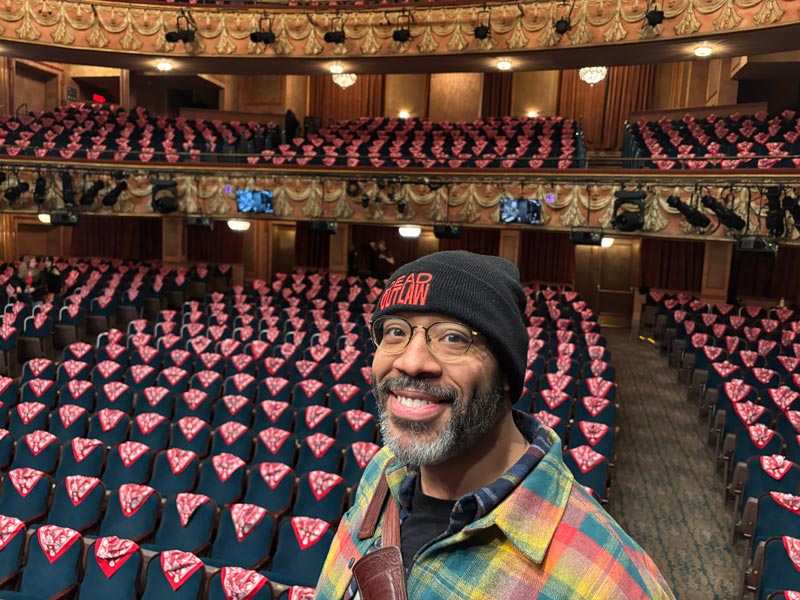
Eddie Cooper at the premiere of Dead Outlaw
This interview series shares the real voices of people working in theater and has received a warm response from many readers. For our seventh installment, we spoke with Eddie Cooper, an actor born into a New York theater family who has built a wide-ranging career from Broadway to Off-Broadway.
The son of a Tony Award-winning actor, Eddie has watched Broadway history unfold from the inside. In recent years, he appeared in the Off-Broadway musical Dead Outlaw and later joined its Broadway production, which closed in June 2025. In this interview, we spoke at length with this born-and-raised New Yorker who knows the world behind the Broadway stage from the inside, asking him about how Broadway has changed, the appeal of Off-Broadway, and his deep affection for Japan. We hope you enjoy this conversation.
A childhood beside the theater and the unforgettable memory of watching his father win a Tony Award
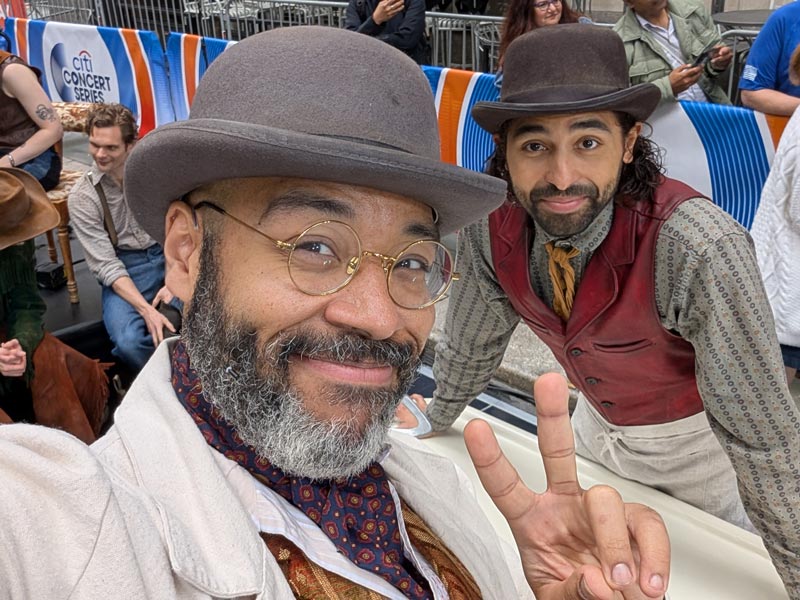
A television taping for Dead Outlaw
Q. How did you become a Broadway actor?
“I grew up in Manhattan Plaza, an apartment complex in New York where many artists lived. It is made up of two high-rise buildings, about a ten-minute walk from Broadway, between 42nd and 43rd Streets and between Ninth and Tenth Avenues. You could go see a Broadway show, come home, get into the elevator, and find yourself standing next to the actor you had just watched onstage. That was completely normal to me. Alicia Keys also grew up in that building.”
Q. What an incredible background. Did it ever surprise you to have famous people so close by?
“Because I was born into that environment, it never felt unusual to me.
In 1997, when I was in high school, my father won the Tony Award for Best Featured Actor in a Musical for The Life. On the night of the ceremony, I was sitting next to him, and I heard his name announced right there beside him. That is not something everyone gets to experience, and it was truly special. You can still find footage of that moment on YouTube.”
Q. I watched the video of your father’s Tony Awards speech, and it was wonderful.
“Thank you. My parents are actors, and so are my brother Alex Cooper and my sister Lilli Cooper, so I was born into a theater family and grew up surrounded by the performing arts. My father never forced any of us to become actors or to pursue theater, but because I grew up so close to that world, wanting to become an actor felt very natural to me. I went on to attend LaGuardia High School, a performing arts high school in New York. It is one of the city’s highly regarded public schools and is also known as the school associated with the musical film Fame.
When I was younger, I resisted being compared to my father, so I tried to focus on straight plays rather than musicals and studied theater in college. But in the end, I really love musicals. Now I use what I learned from theater training while performing mainly in musicals. Being compared to my father does not bother me as much as it once did.”
Q. So it was a path you chose for yourself.
“Yes. That said, because I am a second-generation actor, people sometimes assume I must have been performing onstage since childhood. In reality, I had never been onstage or even sung in front of people before I entered college.
So even though I studied acting in high school and college, work did not come easily after graduation. I decided to take a year-long break. During that time, I went to Japan.”
Q. You lived in Japan for a whole year. How did you spend your time there?
“At the time, I strongly wanted to place myself in an environment completely different from New York. I had always been interested in Japanese culture, so I decided to go and made the leap across the ocean.
Life in Japan was truly wonderful, and I still miss it. What moved me most was the food culture. It was completely different from the Japanese food I had eaten in New York at the time, and I was genuinely amazed by how delicious everything was. I definitely want to visit Japan again someday, and my greatest dream is to perform there. I would do whatever it takes to make that dream come true.
One of the things I encountered in Japan was kabuki. I grew up in New York’s theater district and have seen many historic theaters, but kabuki remains one of the most moving theater experiences of my life. The beauty of the painted scenery, the intricate sets that evoked traditional Japanese architecture, and the elegance of the women in gorgeous kimono were all breathtaking. When cherry blossom petals began to fall, I almost cried. I was also overwhelmed by kabuki’s distinctive stagecraft, from actors coming close to the audience to the revolving stage.”
Q. Hearing that kabuki moved you so deeply, especially after you have experienced so much Broadway theater, makes me feel very proud. In Japan, students sometimes see kabuki as part of their school education, but many of them do not fully understand its value at the time.
“It is the same in the United States. In New York theaters, we sometimes perform morning shows for students. I think there is great educational value in that, but not every student is deeply interested. For performers, there is nothing harder than looking out and seeing students who seem like they just want to go home. Even so, we perform with everything we have, hoping that even one thing will stay with them. Maybe the appeal of classic works is something people come to understand more as adults.”
Q. So it is the same everywhere.
Realizing that his greatest strength is the ability to become almost anyone
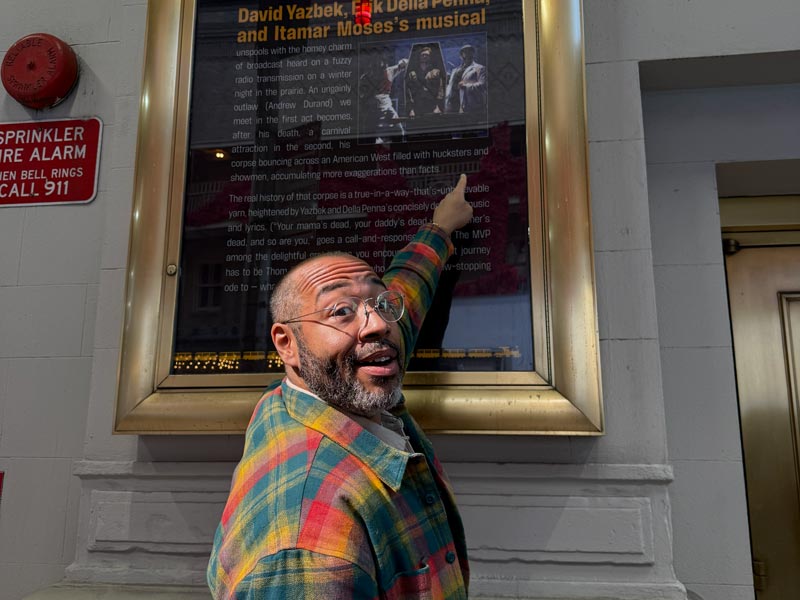
In front of the theater for Dead Outlaw
Q. After returning from Japan, how did you build your career?
“Even after I returned to New York from Japan, work was hard to find for a while, and I went through a difficult period. I kept auditioning, and the first major opportunity I finally received was Little Shop of Horrors at City Center in 2015. It was performed in a large theater with more than 2,000 seats, and it became a major turning point for me.
That show is incredibly well crafted, and it means a lot to me personally. It continues to be loved Off-Broadway and has been embraced by many audiences.”
Q. You gained a great deal of experience Off-Broadway.
“Yes. After building experience on Off-Broadway stages, I finally made my Broadway debut in 2023 in the revival of the musical Parade. Parade is a powerful work rooted in American history, and it was deeply rewarding to perform. Being part of that production gave me a great deal of confidence in my career.”
Q. What part of yourself do you feel is valued as an actor?
“Actually, I think my strength is that I do not have one overly defining feature. In other words, I can slip into many different kinds of roles. Of course my voice and body each have their own qualities, but thankfully, I think my voice and appearance can blend naturally into many different characters.
I have played historical figures, doctors, gangsters, pirates, and even a man-eating plant. The fact that there is no single pattern to the roles I am given, and that I can become almost anything, is a wonderful thing for an actor. It is also a great strength for me. Every role has a strong personality, and each one gives me new energy.”
The joy of seeing Broadway embrace diversity after a long era of white-centered casting, and the concerns that remain
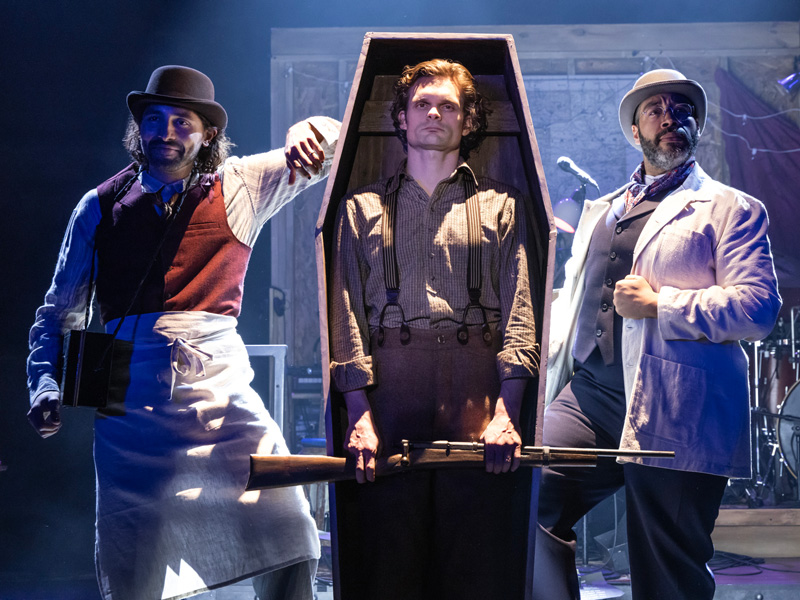
A scene from Dead Outlaw. Photo by Playbill
Q. Having watched Broadway for so long, what changes have you noticed?
“I think Broadway has gradually become a more diverse and flexible place. In the past, unless a show was specifically about Black, Latino, or Asian people, you rarely saw non-white actors onstage. If a role did not specify race, it was usually assumed that a white actor would be cast.
Now that assumption is slowly breaking down, and actors of many different racial backgrounds are appearing onstage. I think that is a wonderful change. As a person of color, I remember how exciting it felt to see actors with skin like mine onstage. Thinking about that, I am reminded again of how extraordinary my father was to receive such recognition as a Black actor in that era, and I am proud to have grown up watching him. For me, the progress of diversity is one of Broadway’s greatest steps forward.”
Q. At the same time, are there parts of Broadway’s recent changes that make you feel a little sad?
“Yes. In recent years, especially in large-scale Broadway musicals, there has been a huge increase in shows based on movies, comic books, and other existing properties. As a result, I feel there are fewer fresh, original works created from scratch for the stage, with original books and music. I think those original works are one of Broadway’s greatest pleasures and one of its true strengths, so I do feel a little sad about that trend.
Of course, I understand why it has happened. Producing a Broadway show today requires millions of dollars. With that level of investment, it makes sense that producers may prefer works that already have name recognition and a built-in fan base because they seem less risky.”
Q. It does feel like original works have become less common. Do you have a favorite original musical?
“One recent favorite is A Strange Loop. It won the Tony Award, and I was strongly drawn to its originality, its structure, and its raw, honest storytelling.
Another memorable original work is Dead Outlaw, the Off-Broadway show I was part of. It is based on a true story, but it is not adapted from a movie or novel.
Dead Outlaw impressed me deeply with the sharpness of its book, the quality of its music, and the meticulous work of the technical team. I feel truly lucky to have been part of that show. It also made it to Broadway, and I hope many people have the chance to experience it.
After the pandemic, the theater industry faced enormous hardship. Many theaters across the United States closed, and Broadway was hit very hard. Audience numbers still have not fully returned to pre-pandemic levels. That is why I sincerely hope Broadway will continue to survive and thrive.”
Why he is drawn to Off-Broadway, where the work is more adventurous and the audience feels closer
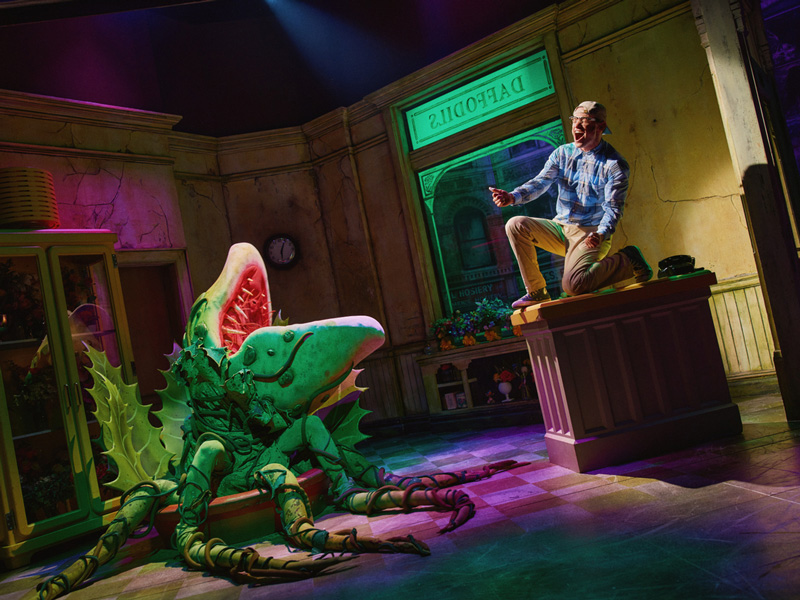
A scene from Little Shop of Horrors. Photo by Playbill
Q. What do you love about New York?
“I truly love this city. I love it with all my heart. There are very few places outside New York, at least within the United States, where I can imagine wanting to live. That is how strongly I am drawn to this city.
The culture, the people, and the city itself all feel iconic and special. New York has an energy that feels almost magical. My roots are here, and I feel very fortunate to have grown up here.”
Q. Do you have your own way of enjoying Broadway shows?
“This may not exactly answer the question, but I often feel the effects of what you might call an occupational habit. Honestly, even while I am watching a show, I am thinking about so many things that I may not be able to enjoy it purely the way a regular audience member does.
For example, I might think, ‘That song must be hard to sing,’ or, ‘The backstage area in this theater is probably narrow, so that must be why they are moving that way.’ I also know actors in many productions, so I often find myself thinking, ‘They are working so hard,’ before anything else. It is a difficult habit to break.
But if I could offer one piece of advice, it would be to research the show as much as you can before choosing what to see. A famous show is not always the show that will suit you best. Who is in it, what the story is about, when it first opened, whether it features the original cast. Knowing even a little bit of that information can make a big difference in how much you enjoy the experience.
The two hours you spend in a theater are almost magical. You do not look at your phone, you do not talk to anyone, and you simply focus on the stage. Many different things happen onstage every day, and each audience member is free to choose where to look and what to take from the performance. If 100 people see a show, there will be 100 different impressions, and reactions and tastes will vary. Something that did not work today may feel wonderful tomorrow. Theater is always alive and always moving. That is what I love about it.”
Q. What are your favorite Broadway shows?
“I especially love Sweeney Todd and Into the Woods. Into the Woods, in particular, was the first show that truly captivated me when my mother took me to see it as a child. It means a great deal to me.
And although it is an Off-Broadway production, Little Shop of Horrors, which I was part of, is also one of the most complete musicals I have ever seen. The music and staging are truly wonderful, and I hope people get to experience it.”
Q. Do you have a favorite theater?
“Each Broadway theater has its own strong personality. I like spaces such as the Booth Theatre, which is relatively small and brings the audience close to the stage. I also love the comfort you feel when you settle into the seats there.
I also like theaters such as Circle in the Square Theatre, where the audience surrounds the stage. Spaces with that kind of circular structure offer possibilities for nontraditional staging, and I would love to see more of them.
I have had more opportunities to perform in smaller Off-Broadway theaters than on Broadway, so I feel a special affection for those spaces. You can sense the audience’s reactions and breathing right beside you, and that energy pulls something out of you as an actor.
Among them, Classic Stage Company downtown is one of my favorite theaters. It is built with old wood, and the floor creaks every time you walk across it. It feels as if the space itself has a soul. It is a very small theater, so you can see the audience’s faces right in front of you. The sound of the wood resonates through the space, and the theater itself feels like a character. Every time I perform there, I discover something new.”
You have a one-of-a-kind talent. Do not be afraid to take the leap
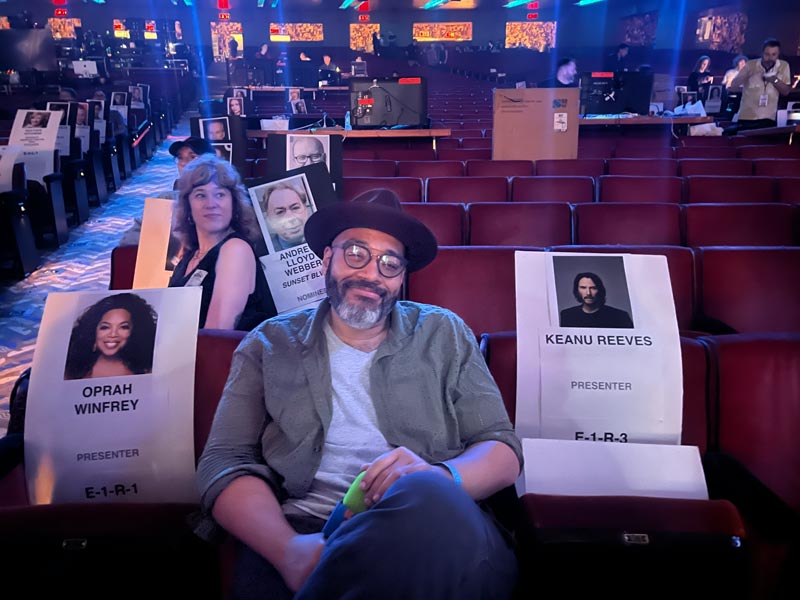
At a Broadway theater
Q. What message would you give to people who dream of performing on Broadway?
“If you dream of standing on a Broadway stage, there may certainly be a language barrier. Many productions require you to perform in English, so that is one major challenge. But beyond that barrier, I believe there is a special talent that only you can bring. I think that potential is enormous.
I understand the feeling of underestimating yourself. It is what people often call impostor syndrome. I know that even well-known actors experience that same feeling.
But the anxiety or doubt you feel is not always the truth. What an audience wants and what moves them can be very different from what you imagine. You may have something within you that audiences will be unexpectedly drawn to.
I have had moments when I stepped offstage and thought, ‘That did not go well today.’ But on those very nights, audience members or directors have sometimes told me, ‘Tonight’s show was special,’ or ‘Your performance was wonderful.’
That is why I want people to remember that their own feelings are not always what others are receiving. If you have a passion for theater, please try. If you do not, you may always wonder whether something could have been different if you had taken that chance. So please do not be afraid to take that first step.”
Q. Finally, do you have a message for Broadway fans?
“Please come to New York and experience Broadway and Off-Broadway theater. Every day, all kinds of musicals and plays are being performed, and there is a special kind of time here that you can only experience in this city.
What I especially want to share is the appeal of Off-Broadway. There are so many wonderful shows being created there in a way that is different from Broadway. Of course, Broadway has many exciting productions, but in smaller Off-Broadway theaters, you often encounter more innovative and adventurous work. I hope people will broaden their perspective and look beyond large-scale spectacles to discover the depth and excitement of theater itself in smaller venues.
For those of us striving to create better work Off-Broadway, audiences are essential. Your reactions and support reach us directly, creating a special moment where the stage and the audience resonate with each other. I hope you will experience that kind of theater for yourself.”
A note from the interviewer
The first time I exchanged words with Eddie was at a theater-related event. As I listened to him talk about growing up in a New York theater family, I began to think that it would be fascinating to interview a New Yorker who truly knows Broadway from the inside. That was how this interview came about.
We met for the interview at a Japanese restaurant in the theater district. As we shared grilled yellowtail, I was struck by how warmly he spoke about Japanese culture and how sincerely he expressed his respect for Japan’s performing arts. Eddie spoke directly and earnestly about his dream of working in Japan one day. Coming from someone who knows Broadway, one of the world’s highest stages for theater, those words felt especially moving.
What began as a lively conversation about Broadway eventually expanded into a deeper discussion about the appeal of Off-Broadway. I once heard a theater fan say, “Once you fall into the world of Off-Broadway, there is no going back.” Through my conversation with Eddie, I finally felt that I understood what those words meant. Experimental and daring works that are difficult to realize on Broadway are being born every day in small Off-Broadway theaters. Perhaps that is why so many people are drawn to the chance to witness those moments as they happen. Eddie’s words carried real conviction and authenticity because he knows the appeal of both Broadway and Off-Broadway.
Styles, actors, trends, and the stories behind each production all continue to change with the times on Broadway. Yet this interview reminded me that no matter how much the form changes, the passion at the heart of creation remains the same. The magic of Broadway is sustained by the people who stand on its stages and by the people who come to the theater. I am deeply grateful to Eddie for helping me feel that so clearly.
Written by Sayaka Imada
See more Broadway Guidepost articles
Leave your Broadway tickets to At Broadway
 At Broadway is a website specializing in Broadway musicals, operated by the New York-based travel company At New York. We offer discount Broadway tickets and helpful Broadway information.