
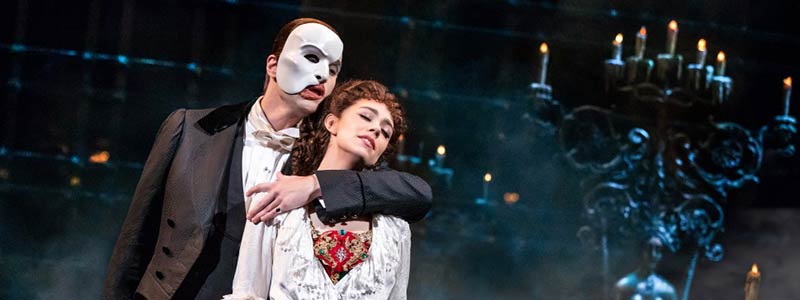
Since its Broadway premiere, the 1988 debut of the long-running musical “The Phantom of the Opera” has captivated audiences. Why does it continue to be loved by so many? Here, we take a deep dive into what makes this classic musical so special.
Beloved since 1988: “The Phantom of the Opera”
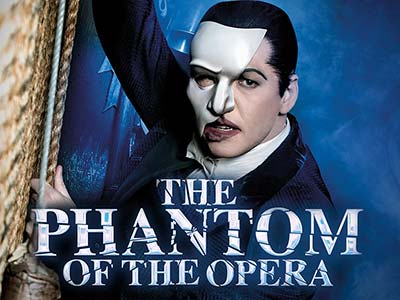 Based on the 1911 novel by Gaston Leroux, this stage adaptation was created by composer Andrew Lloyd Webber and director Harold Prince. It began performances at the Majestic Theatre in January 1988 and went on to win seven Tony Awards that year, including Best Musical, with three additional nominations.
Why “The Phantom of the Opera” became a record-breaking run
The original novel by Gaston Leroux is set in Paris around 1905. The first stage adaptation of the story as a musical premiered in London’s West End at Her Majesty’s Theatre on October 9, 1986.
In London it is the second-longest-running musical after “Les Misérables.” On Broadway, since opening in 1988, “The Phantom of the Opera” has set and continued to extend the all-time record for the longest run. What keeps audiences coming back? What exactly is so compelling about the piece? Here’s a clear, simple breakdown.
A heartbreaking, bittersweet story
The musical portrays a tragic romance between the disfigured Phantom who lives beneath the opera house and the young soprano Christine. Torn between illusion and reality, he abducts the woman he loves in a desperate bid to keep her by his side, creating a lush, gothic tale of beauty and darkness.
Andrew Lloyd Webber’s score channels every shade of emotion, leaving audiences with aching sadness and striking beauty in equal measure.
Spectacular stagecraft and visuals
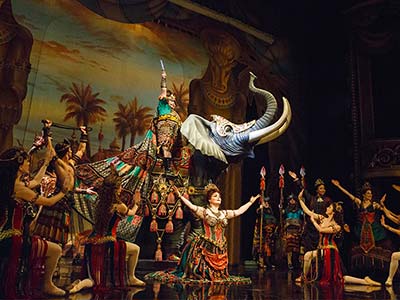 Rapid scene changes, clever perspective work, and meticulously detailed sets bring the Phantom’s world to life. One moment you’re watching a glittering performance at the Paris Opera; the next, the stage transforms in an instant into the Phantom’s shadowy underground lair.
Atmospheric smoke for the subterranean passageways, ornate décor for the opera scenes—every element heightens the story. For a musical that debuted in 1988, the scale and ingenuity of the stagecraft still draw the audience irresistibly into the Phantom’s realm.
The remarkable backstory of how the musical came to be
Andrew Lloyd Webber—composer, book writer, and the driving creative force behind “The Phantom of the Opera”—helped define late 20th-century musical theatre.
After hits like “Cats” and “Starlight Express,” he turned to “Phantom” in 1984.
At first, seeing the 1925 and 1943 film versions didn’t spark a stage concept. But discovering Leroux’s novel in a New York secondhand bookshop unlocked the inspiration for a musical.
He later said, “I’d been wanting to write a grand romantic story since the start of my career, but I was stuck—then ‘The Phantom of the Opera’ appeared before me.”
The unforgettable anthem “Music of the Night”
Lloyd Webber’s score draws inspiration from Ken Hill’s 1976 “Phantom” and from Mozart, shaping a grand-opera sound. Yet it remains distinctly musical theatre, weaving spoken phrasing into the music to create something new.
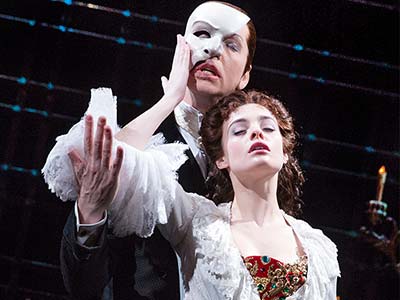 The signature ballad “Music of the Night” is the Phantom’s confession of love to Christine. His impossible yearning carries a faint glimmer of hope on a gorgeous melodic line that resonates long after the curtain falls. In the moment pictured here, as the Phantom sings “Music of the Night,” Christine’s fear slowly yields to the allure of his voice, and the air between them turns almost intimate.
Before you go: listen to this must-hear song
The show’s emblematic number, “Music of the Night,” is essential pre-show listening. Here is a video and a short excerpt of the lyrics.
Let your mind start a journey to a strange new world. Leave all thoughts of the life you knew before.
Let’s set off together into a strange new world.
Let your soul take you where you long to be. Only then can you belong to me
Follow your heart—then you will be mine.
Floating, falling, sweet intoxication. Touch me, trust me, savor each sensation.
Surrender to me—reach for me, feel every sensation.
Let the dream begin, let your darker side give in. To the power of the music that I write.
Yield to my power—to my music—and the dark will be tamed.
The power of the music of the night
Within the music of the night
Definitive 20th-century stage design
Direction is by Harold Prince—whose credits include “West Side Story” and “Cabaret” and who earned 21 Tony nominations over his career—and costumes by Maria Björnson, who won the Tony for Best Costume Design of a Musical for this production.
Their work—celebrated as a pinnacle of stage art—is often described as sumptuous, mysterious, and grand.
The chandelier and the vast under-stage lair take inspiration from the real Paris Opera, the Palais Garnier. With lavish ornamentation, imposing scenic effects, and a sweeping score, the show cemented its status as a defining classic of our era.
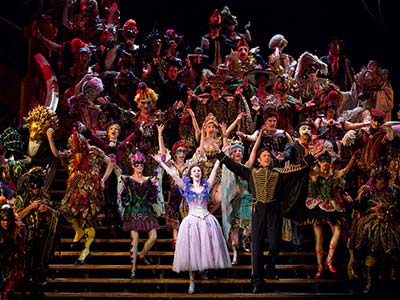 In the “Masquerade” sequence—Christine and Raoul’s engagement celebration—the jealous Phantom crashes the festivities in a red skull costume. The dazzling ball shatters in a breathtaking instant.
The masquerade features more than 200 specially designed costumes. Together with the spiral staircase and ornate décor, the scene conjures the glamour of Parisian high society circa 1905.
What to watch for on stage
The massive chandelier overhead
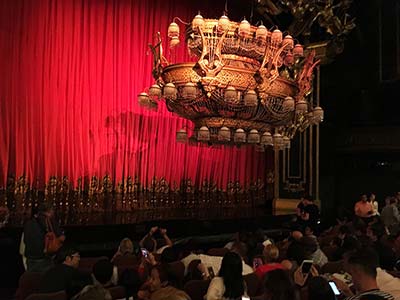 The chandelier is a star in its own right, heightening the drama as it rises—and falls—before your eyes. For the best view throughout the show, sit in the front or center of the Orchestra, or in the Front Mezzanine. If you’re seated upstairs, consider showing your ticket to staff and taking a quick look at the chandelier from the front of the Orchestra before heading to the Mezzanine.
The boat sequence to the Phantom’s lair
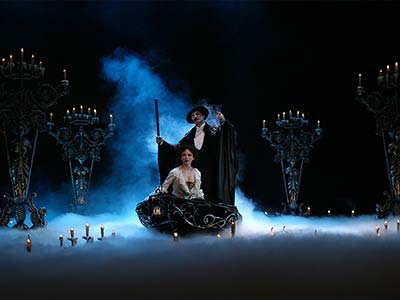 Smoke and shimmering light make it feel as if a real lake lies across the stage, amplifying the terror and mystery of the Phantom’s underworld. Christine’s uncertainty—being led into the unknown—contrasts with the Phantom’s mingled joy and anxiety as he finally brings her into his domain.
The interplay between the Phantom and Christine
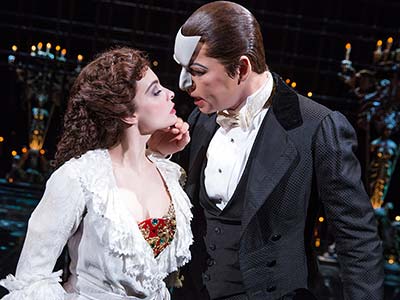 At its heart, the story is a triangle—Phantom, Christine, and Raoul. Meeting Christine changes the Phantom, a feared figure who curses those around him. Will his love reach her? Will Christine defy the world to choose the Phantom, or return to Raoul? The performances keep you guessing right up to the end.
Get familiar with the story first
To enjoy the show even more, watch the film adaptation of the original novel—or the 2004 movie based on the musical—so that with the story in mind, you can follow the stage action even if you miss a line. If you’d rather avoid major spoilers, read the synopsis below to get the basics before you go.
You can also check out our staff’s performance report for on-the-ground tips and impressions.
Cast
The Phantom: Ben Crawford
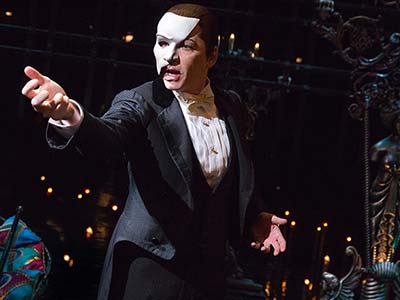 Ben Crawford, currently starring as the Phantom, is a seasoned leading man with credits including “Les Misérables,” “Shrek the Musical,” “Big Fish,” “On the Twentieth Century,” and “Charlie and the Chocolate Factory.” His Phantom is imperious and powerful yet tinged with sorrowful dignity.
Christine: Ali Ewoldt)
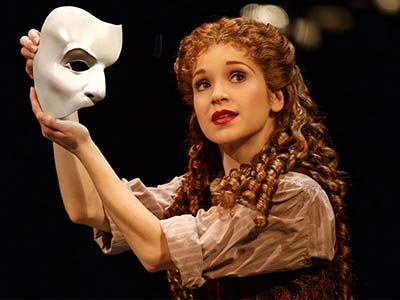 Ali Ewoldt is the first Asian (Filipino) American actor to play Christine on Broadway. She previously starred in “Les Misérables” (2006) and “The King and I” (2015), joining “Phantom” in 2016. Beyond her charm and grace, her vocal power is undeniable—her rendition of “Think of Me” is thrilling.
The Phantom of the Opera – Theatre
Majestic Theatre
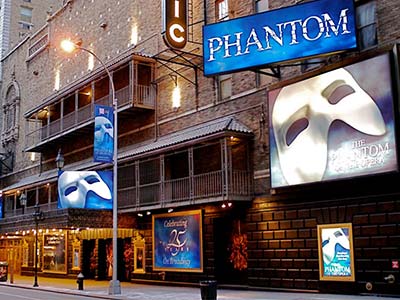 Address: 245 W 44th St, New York, NY 10036(Map )
Opened in 1927, the Majestic underwent a multi-million-yen renovation to prepare for “Phantom”’s 1988 Broadway debut. Experiencing this classic in a storied theatre makes for an unforgettable night.
 Broadway Musical Discount Tickets – On Sale Now!
Find the best Broadway ticket deals right here – faster, cheaper, and backed by local expertise. Get ready to experience the magic of Broadway!

- Get discount tickets easily with instant booking
- The most detailed musical guides and reviews
- Dedicated support throughout your Broadway experience