
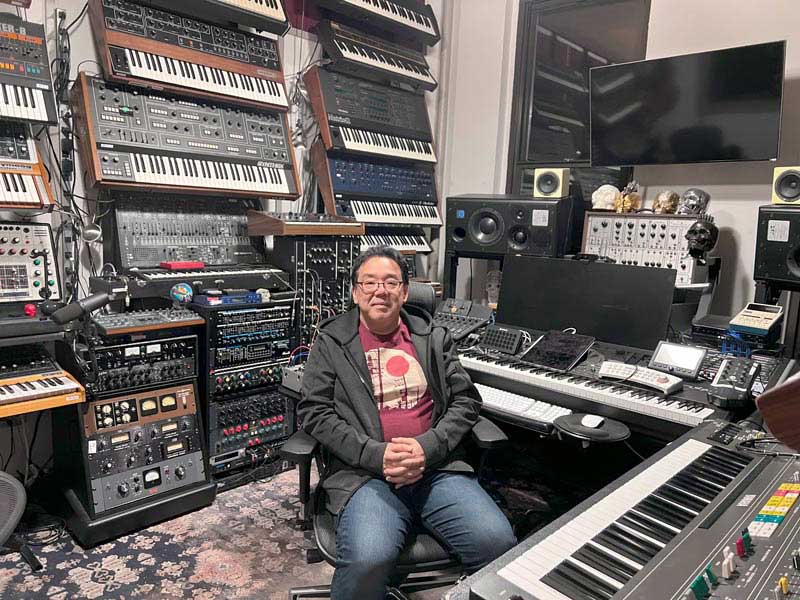
Hiro Iida in his own studio
This two-part interview explores the career and influence of Hiro Iida, one of the most sought-after music designers on Broadway today and a key figure behind the sound of its new era.
Working under the title of Electronic Music Designer, Hiro Iida helped establish the sonic foundation of contemporary Broadway. He has programmed and designed music for a wide range of productions. His expertise has made him an indispensable presence in modern musical theatre, and he is now widely regarded as one of the industry’s leading figures.
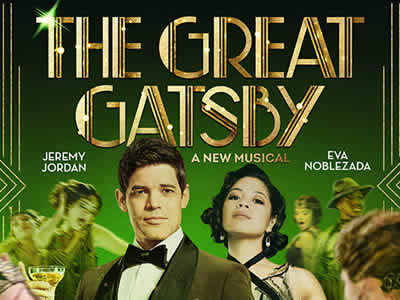
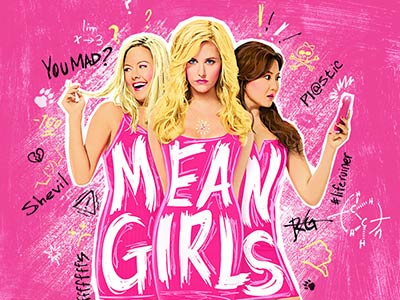
Hiro’s Broadway credits include MJ The Musical, The Great Gatsby, Mean Girls, Tootsie, Wonderful World, The King and I, Shrek, Diana, Spider-Man, Beautiful, The Band’s Visit, and Kimberly Akimbo, among many others. Beyond Broadway, he has also contributed to major productions in his home country Japan, sharing his technical knowledge and creative approach on works such as King Arthur, Death Note The Musical, and Ikiru (To Live).
His presence on Broadway not only inspires, but also offers audiences a deeper appreciation of the artistry behind the productions they see. Despite a demanding international schedule, Iida generously took the time to speak with us for this interview.
In Part One, we explore Hiro’s background and his work on Broadway. For his tips on enjoying Broadway and what audiences should pay attention to, please read Part Two here.
A life-changing encounter with the synthesizer
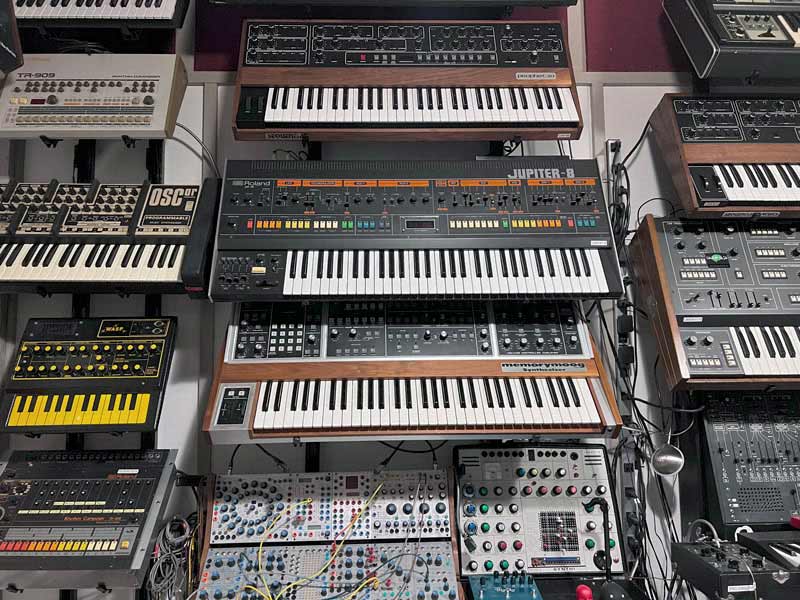
A collection of vintage and modern synthesizers in a New York studio
──What first sparked your love for synthesizers?
“I first discovered the synthesizer when I was in elementary school. Back in the 1970s, my older sister, who was preparing for music college, gave me Isao Tomita’s album ‘Clair de Lune’. Tomita was a pioneer of synthesizer music, and this was his first album, a complete synthesizer reinterpretation of Debussy’s ‘Clair de Lune’.
On the back of the record sleeve there was a photo of the synthesizer itself, and seeing it for the first time was absolutely stunning. It felt futuristic and unlike any classical instrument I had ever known. Today, synthesizer sounds are everywhere, but back then we had no idea what kind of music would come from such a machine. That entire album was filled with sounds that felt completely new.
Around the same time, Roland – then, still a relatively small company based in Osaka, opened a showroom in Tokyo. Hearing that visitors could interact and try the synthesizers on display, even learn how to use them, my father and I began going. I must have been about eight or nine years old. On Sundays, after finishing a test at my cram school, it was like my reward to stop by the showroom in Akihabara. There I learned directly from graduate art university students and professional musicians. Because I was so young, I absorbed everything physically and intuitively. At the time I was also studying cello and piano, but I was especially fascinated with creating sounds on the synthesizer.”
──So you were already playing with synthesizers at such a young age?
“Yes. Still, when I graduated from high school, I wasn’t sure whether to follow a path in science or in music. My teacher asked me if I was really ready to give music up. That conversation stayed with me through my final year of high school, and in the end I decided to commit fully to music. I wanted to study synthesizers seriously. After doing lots of research, I discovered that Berklee College of Music in Boston had a program in electronic music, so I decided to study abroad.”
“At that time, there were no four-year universities in Japan that taught electronic music academically, nor were there teachers who specialized in it. Europe was the center of classical music, but America was clearly the place to go for electronic music. After graduating high school, I studied English for about six months before leaving Japan. I was fortunate to learn conversational English from an American couple who taught at a nearby American school. I switched from exam-style English to practical communication, focused on preparing for the TOEFL, and worked hard until I reached a score that allowed me to begin my studies abroad.”
Berklee Years: World class mentors and little to learn at first
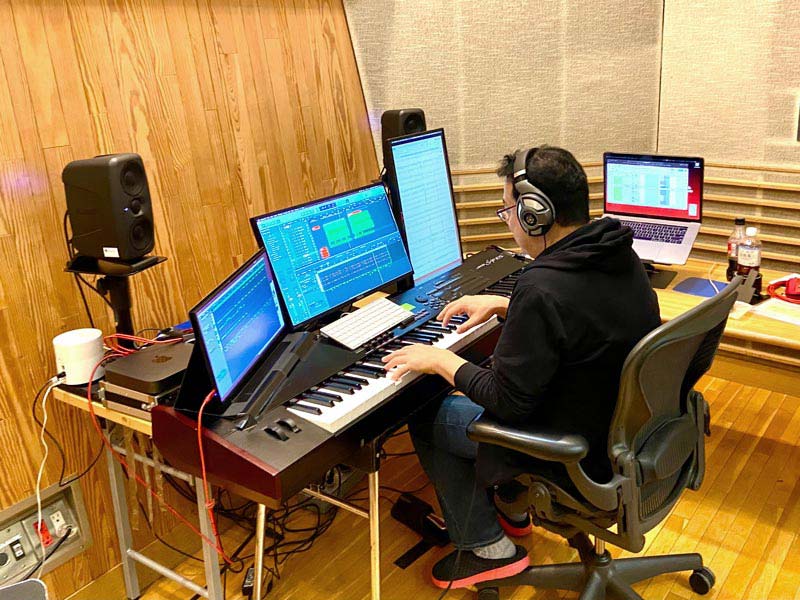
Recording and building tracks
──What did you study at Berklee College of Music?
“The year I entered Berklee, I was told the electronic music major I wanted to pursue had just been discontinued. Technology in electronic music was advancing so quickly that the curriculum simply couldn’t keep up. I decided to spend the first year focusing on English while waiting to see what would happen.
Even without a formal course, the school still had an exceptional selection of synthesizers. Professor David Mash, who would later become my mentor, recognized my enthusiasm and told me I was welcome to come to the synthesizer lab every day. So during my first year, I studied English and spent my time freely exploring and learning in the lab.”
──Unlimited access to a lab full of synthesizers sounds very Berklee.
“As for classroom study, there was very little that felt new to me. In terms of classroom lectures, there was very little that felt new to me, but the lineup of gear in the lab was outstanding. Because Berklee is an educational institution, rather than following trends, equipment was selected carefully with the curriculum in mind. On top of that, my mentor, who was also the dean, personally taught me directly. Being able to learn the core principles of electronic music from him was incredibly fortunate.
The reason classroom work felt unnecessary is that the first- and second-year lessons repeated what I had learned at the Roland showroom between ages eight and thirteen. When a new synthesizer track was introduced in my second year, there was nothing fundamentally new for me. It was all material I had learned as a child. I took test-out exams to skip ahead, but since the program was new, the advanced classes weren’t ready yet. So I would spend my time in the lab. The following semester I tested out again, and once again, with no next-level class prepared yet, I went back to the lab. That cycle repeated, and I couldn’t help but laugh about it.”
──It’s surprising there was so little new to learn at a world-class school. Was it still worth attending?
“Yes. It was absolutely worth it. David Mash continued to introduce me to opportunities even after graduation. He helped shape Berklee into what it is today, a school that teaches musical technology, eventually serving as a vice president. We are still in touch.”
Realizing electronic music transcends race – why fundamentals come first
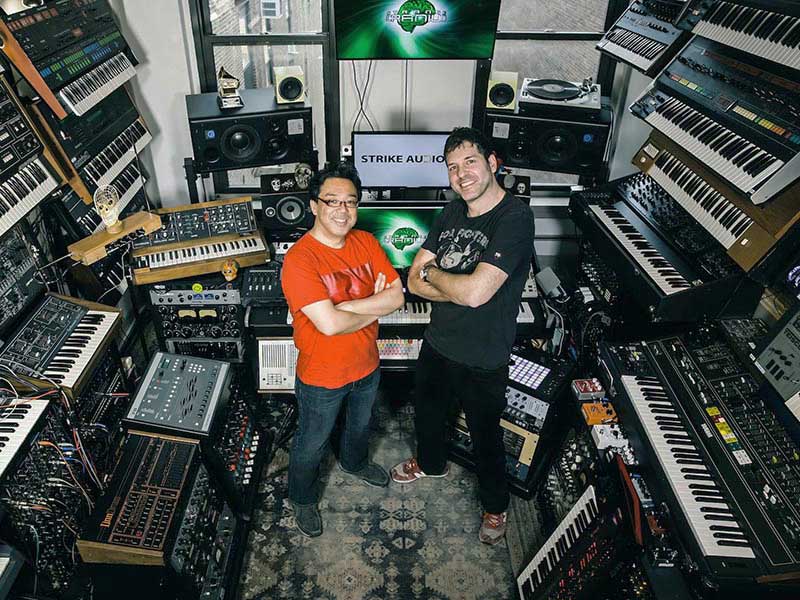
At his studio, Strange Cranium Studios, with business partner Billy Stein
──How did you develop technique that could complete at a global level on Broadway?
“One realization I had after entering Berklee College of Music was that synthesizers and electronic music are largely independent of race or ethnicity. In genres that are closely tied to cultural or racial identity, such as gospel or country, people may judge the music through that lens. No matter how strong your technique is, if your identity does not match the character people associate with that music, you can still be filtered out. A well-known example is how rare it is for Asian performers to be cast in a Michael Jackson musical.
Even today, when diversity is widely discussed, there are still deeply rooted assumptions, such as the idea that gospel sounds more authentic when performed by Black musicians, or that rhythm comes more naturally to certain groups. This is not necessarily discrimination so much as the images and expectations people carry.
Electronic music is different. The technology itself is relatively new, and the tools are industrial products. With a certain budget, whether you are a professional or an amateur, you can purchase exactly the same instruments and build the same setup. That shared starting point is fundamentally different from instruments like violins or pianos, where the instrument itself can dramatically affect the sound.”
──So if the field is less shaped by identity or wealth, where do differences emerge?
“It comes down to how you use your mind – how you think. There’s no inherent disadvantage in being Japanese, European, Asian or have roots in any other part of the world, I can engage with the instrument in a very positive, confident way. That’s a strength I probably wouldn’t have noticed if I had stayed in Japan.
In fact, many of the world’s most influential synthesizer artists come from outside the English-speaking world – just look at the likes of Isao Tomita, Yellow Magic Orchestra, Kitaro, Germany’s Kraftwerk, France’s Jean-Michel Jarre, Greece’s Vangelis. Their success proves that you can reach the highest level regardless of language or nationality. That sense that you can ‘win’ even in America, and that everyone starts from the same place, is one of the great strengths of electronic music.”
If you were asked to create the sound of “walking on a cloud”, how exactly would you conceptualize it?
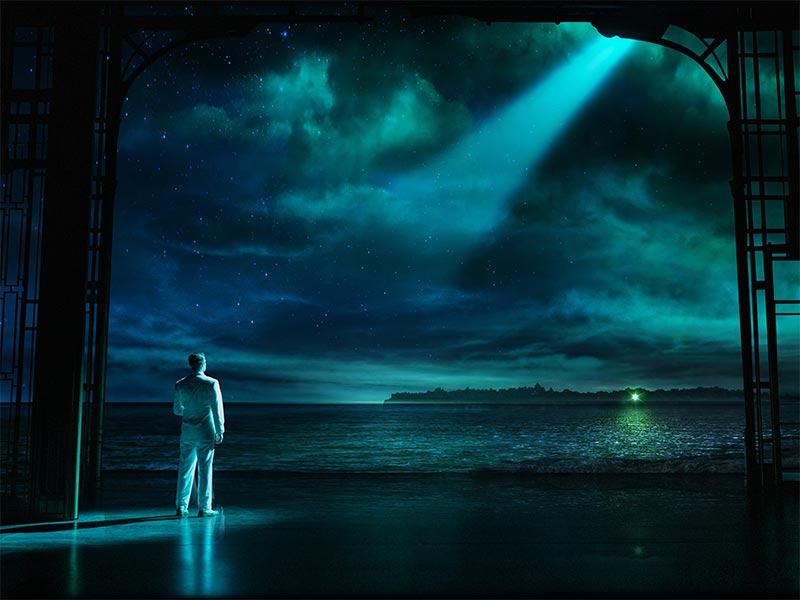
A scene from The Great Gatsby musical (Photo by Production)
──From that equal starting line, what helped you pull ahead?
“The most important thing for me was learning the core of sound under my mentor David Mash. I often compare sound design to learning to drive a car. You don’t learn to drive a specific manufacturer’s vehicle – you learn the fundamentals and principles of operating a vehicle, and then apply those fundamentals and principles to any vehicle you drive.
The same applies to synthesizers. If you only learn how to play instrument A, you cannot perform at the same level when instrument B arrives. David taught me to study the shared core across A, B, and C so I could apply it to any sound. That’s an area where I grew tremendously during my time at Berklee.”
──If you don’t mind getting a little too technical here, what do you mean by the core of synthesis? If we go a bit deeper technically, what exactly do you mean by the “core” of synthesis?
“At its core, synthesis is about basic operations: addition, subtraction, multiplication, and division – which is synthesis and division. The counterpart to synthesis is analysis, and these two always go together. With these four operations, you can recreate any sound.
I trained myself to think in terms of calculation and analysis: how to break a sound down, and how to rebuild it. Once you understand that process, it doesn’t matter what instrument appears – you can create any sound. Synthesis and analysis are inseparable. If you can’t analyze a sound, then you can’t synthesize it. To create the sound you must first understand it. For example, when you taste pasta dish and instantly recognize the ingredients and cooking method, then you can reproduce the same flavor./p>
In my work, I’m often asked to turn words into sound. Sometimes the request is no more than a few words. If someone were to ask me to “make it sound like you’re walking on clouds,” the question becomes whether or not I can draw from my internal library, analyze what that sensation implies, and then synthesize a sound that truly feels like walking on clouds. The ability to move language to a sound is ultimately what this line of work demands.”
Declining all work from home country to break into New York’s music scene

Times Square where Broadway theaters line the streets
──Back to your career path. What brought you to New York and into Broadway?
“After Berklee I considered graduate research in computer science at Stanford, but I was invited to stay and teach electronic music. I taught at Berklee for six years on an H-1 visa. I received Best Teacher honors from the International Association for Jazz Education and from Berklee, which helped me obtain an artist green card for my contributions to higher education. With permanent residency secured I decided to leave Berklee and move to New York.”
──Why New York?
“Since Boston does not really have a music industry infrastructure, those wanting to take the next step generally consider moving to New York, Los Angeles, or Nashville. The coasts have very different musical characters. I took my parents’ advice to go to New York while I was young, since it would never be too late to make it in LA.
So I came to New York in 1997. Musicals had nothing to do with that decision. For the first eleven years, I had no connection to musical theater at all – no network, no colleagues, nothing.”
──What did you do in those first eleven years?
“My first year in New York ended with nothing but meeting people. I met someone, got introduced to someone else, and went around pitching myself as someone who could create sounds using synthesizers. Before I knew it, a year had passed and I had burned through all my savings without landing a single job.
Gradually, recording work from Japan began to increase, and I stayed busy doing recording and sound design. In the 1990s, it was a trend for Japanese record labels to record in New York and for Japanese commercials to be filmed there, so I had the chance to work with many different artists. I was grateful to have work, and for a while I put my desire to break into the New York music scene on hold and focused mainly on projects from Japan.
Then one day, a Japanese artist told me, “Japanese people will never really be able to break into the American music industry, so we have to stick together and pass work around among ourselves to survive.” When I heard that, I realized that if I kept working with these people, I would never move forward. I turned down all of my clients.
The only exception was Akiko Yano. Even back then, she led rehearsals as the clear boss, giving musical direction regardless of race or nationality, always focused on making something good. I thought she was incredible and wanted to keep working with her, so I did. We still work together often.
After cutting off all work from Japan, I started getting recording and commercial work in the U.S. The biggest of these was music for WWE, which led to a full-time position. For nearly three and a half years, I commuted to Stamford, Connecticut for that job.
But after spending three years in Connecticut, I started to feel like I was becoming “someone who isn’t really in New York anymore.” I knew that was a problem. Right around then, an offer came in asking if I wanted to work with U2. The chance to work with a legendary band like U2 was too tempting to pass up, so I left the WWE job, moved back to New York, and took it. That project turned out to be the Broadway musical Spider-Man. That was my first connection to Broadway.”
──Finally Broadway enters the picture.
“That was in 2008 when I was about forty. I did not even like musicals then. I had never really watched them and had never set foot backstage. I did not know how anything worked in a theater. No one in the company knew me either. I started from zero.”
──How did the Spider-Man offer come about?
“Through my now business partner Billy Stein. When Julie Taymor set out to create a new production, she wanted to do it with a new team rather than the one that had built the old Broadway. Billy was on the music team and remembered my work from another recording session. He called me.
He didn’t say it was for a musical. He just said I could work with U2, which sounded great, so I left the wrestling job and came back to New York, only to learn it was a musical project. And that is how it began.”
New York is survival of the fittest: breaking in meant breaking out of a small-island mindset
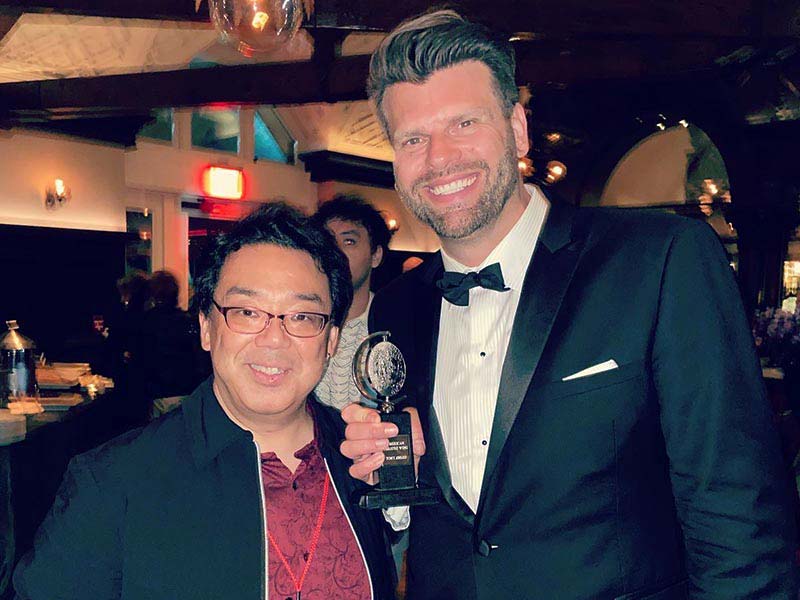
At the Tony Awards with sound designer Gareth Owen after winning Best Sound Design
──Have you ever felt defeated in New York?
“I have felt defeat, but I do not think I have been defeated. You don’t die from it, and tomorrow still comes. However, there are issues tied to identity that you cannot control, like your race for example. In the theater industry, there can still be a lingering bias that ‘Asian people don’t belong.’ I’ve been stopped at stage doors where I’d passed through many times before, as a technical staff member, and told, ‘Authorized personnel only,’ or ‘Leave deliveries over there.’
Still, there is no point in giving up. The reality is that the number of Asian people like me in this industry is small, so the only solution is to build relationships with the people there. When a security guard assumes I’m a delivery person, I explain that I work there, ask his name, greet him with ‘Good morning,’ tell him I’m heading out for Starbucks, or bring back donuts. There is a lot you can do.
I often describe New York as a wild kingdom ruled by the strongest and the fittest, where the loudest voices and strongest personalities win, and those who are ‘weak’ are forced aside. Just ride the subway and you’ll understand – most, if not everyone around you will be of different education, economic, and racial backgrounds. Almost no one is like you. Misunderstandings happen constantly, and that’s normal.
With such an enormous level of discrepancy, mismatch is normal. Someone who arrives from a more homogeneous environment like Japan can easily end up feeling crushed if they don’t shed that mindset. You have to reset your standard to New York and be able to say who you are regardless of those around you. Difference is not vertical but horizontal.”
──That idea of horizontal difference resonates especially with anyone who has been tested in New York.
“Even saying, ‘I can’t speak English,’ immediately places yourself below others. Just say, ‘I don’t speak English,’ and you simply state a fact. You grew up speaking Japanese – of course you don’t speak English like a native. It’s more like, ‘You don’t speak Japanese, so I’m speaking English for you.’
What matters is not what you sound like or your pronunciation, but what you actually say. A clear example of this is the UN – the common language is English, but it’s doing its job as a common communication tool. My line of work is simple: make better sound than anyone else. If the work is undeniable, then labels don’t matter. Feeling defeated by a language barrier is unnecessary. My struggle does not concern anybody else, so I must focus on carving my own path.”
──This is starting to sound like a mindset seminar for studying abroad.
“Yeah maybe so [he laughs]. To go from an island mindset to the world, you sometimes need the nerve to cut through and stop worrying what others think.”
In New York, giving 100% Isn’t Enough — 140% Is the bare minimum

A scene from Spider-Man (Photo by Production)
──What work in New York earned you a strong recognition?
“In musicals, I built a system to perform computer-based sound as instruments. Before Spider-Man, when the director wanted a sound, the team would buy a piece of gear. The enormous budget of that production pushed us to run sounds created on synthesizers from a computer during each performance. At the time, combining computers with live performance was unstable. We proved it could be done. That approach is now standard not only on Broadway but also on the West End and in many other markets.”
──Was there a moment when your reputation clearly shifted?
“When I worked at Radio City Music Hall, I realized how different a theater responds compared to a small studio. Compliments increased fast after that. People wanted to use those sounds. It was a revelation. To create sound for a theater, you need to think completely differently. I reexamined my work, analyzed it again, and started designing specifically for the space. After that, the response changed quickly. I began hearing comments like, ‘That sounds great,’ or ‘We want to use that sound,’ far more often.”
──How do you keep improving your technique?
“When a show is finalized and approved, I always listen through every sound that same day. Otherwise the sense of achievement makes you forget everything. Before the memory fades, I review what was wrong over the months and how we fixed it so I can skip the detours next time. I also rebuild or adjust for each remount and city. For example, with Death Note I have changed sounds every time it has returned. Many productions simply reuse the data. I prefer to recheck and revise because players, venues, and contexts change.”
──That commitment is likely why people value working with you. Anything else you hold onto?
“__That commitment is likely why people value working with you. Anything else you hold onto? “Continuously delivering 140 points. When someone asks for a sound, ‘That was good’ isn’t enough. You have to overwhelm a room full of elite professionals—people chosen from the top of their fields – with sound so undeniable that no one can argue with it. And even then, that 140 is merely the passing grade. In New York, there are countless people who can deliver that level. If you aim for 100, you’ll just line up next to everyone else. You have to make 140 your standard and keep it there. When the ball comes, you hit it every time. That’s my rule. ”
When skill is a given the people who get hired are easy to work with
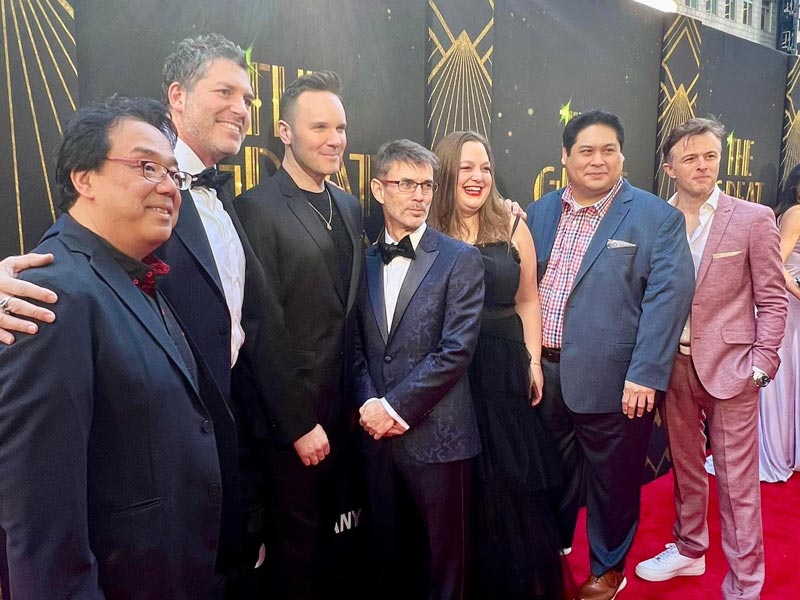
On the opening night red carpet for The Great Gatsby
──Beyond technique, what else makes you the person people choose?
“Be the person others want to work with.
Let me talk about temperament. In the end, it is not only skill but character. While it might sound contradictory to what I’ve already said, deciding factor isn’t skill, I believe it’s character. Technical competence is a given, and many people I work with are tremendously competent. When a director must choose between two equally skilled people, they choose the one who is enjoyable and easy to work with. If you frown for a moment when someone says ‘I want to try this,’ it can close a door. If you say ‘sounds good,’ it opens one. Those small differences decide who gets the call.”
──What do you do to be that easy collaborator?
“When someone asks for something, I first say yes. Sometimes I suspect it may not be necessary, but I don’t grimace or resist before trying. The cost is usually small, and trying is better than spending time not trying. If it fails, we laugh and move on, and the work improves through that trial and error. Additionally, it’s often said that it’s hard to read emotion through facial expression on Japanese people, so I’m mindful to keep my tone and expression positive so people know where I stand.
That kind of relationship makes it easier for me to ask for help too. For anyone who wants to break in, my advice is simple. Show up and stay. Show your face. If I call and one person can arrive in ten minutes and another cannot until next week, I will call the first person. Be never available and you will miss the opportunities.”
End of part one of the interview
Up to this point we have traced Hiro’s path and achievements. Called a genius by peers he refuses to coast. In New York he keeps producing work at 140% while maintaining presence, positivity, and trust with collaborators. For many readers, his story may be a reminder of what it takes to become the person others rely on to shape the sound of a production.
In part 2, we then asked Hiro for insights that will help audiences enjoy Broadway even more such as what exactly makes Broadway special, and what he finds most rewarding about working on productions. Please continue to the second part.
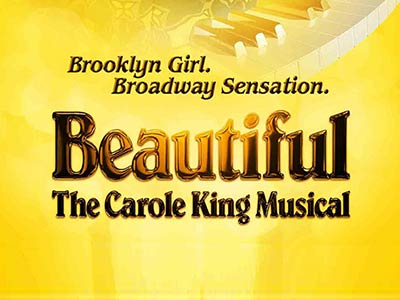
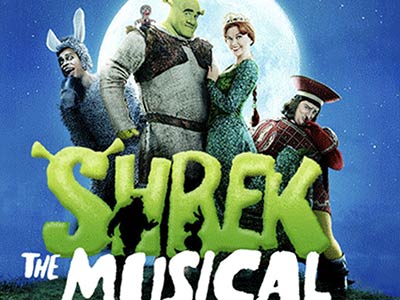
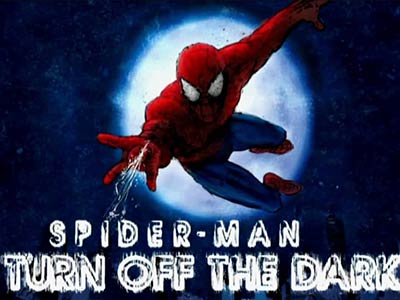
Musicals Hiro Iida has helped shape the sound for


 Broadway Musical Discount Tickets – On Sale Now!
Find the best Broadway ticket deals right here – faster, cheaper, and backed by local expertise. Get ready to experience the magic of Broadway!

- Get discount tickets easily with instant booking
- The most detailed musical guides and reviews
- Dedicated support throughout your Broadway experience