
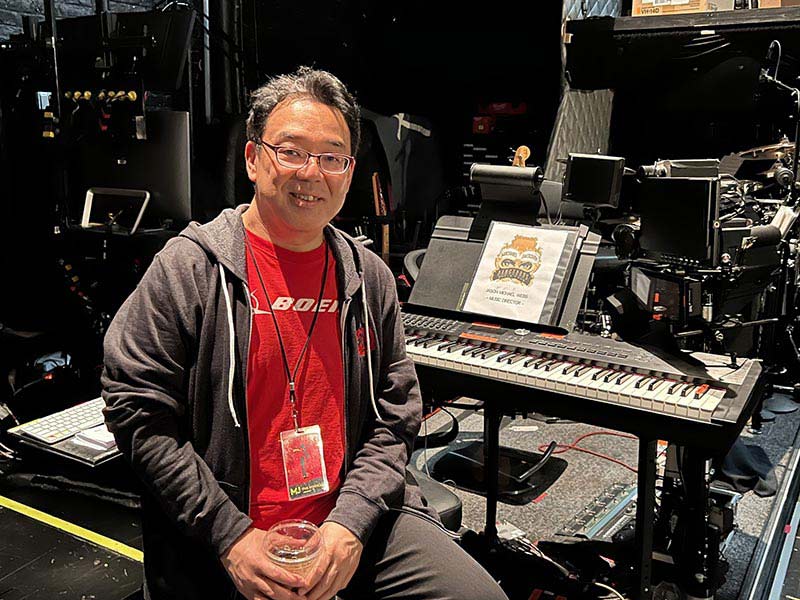
Hiro Iida during rehearsals for MJ
The second half of our interview with Hiro Iida, an Electronic Music Designer working at the forefront of Broadway. In this part, he shares what makes Broadway special and offers behind-the-scenes stories from the job.
You can read the first part here, which covers Hiro’s background. Together, the two parts form a rich and moving read; we hope you enjoy it.
Why Broadway is exciting: building new shows from scratch and feeling the audience react
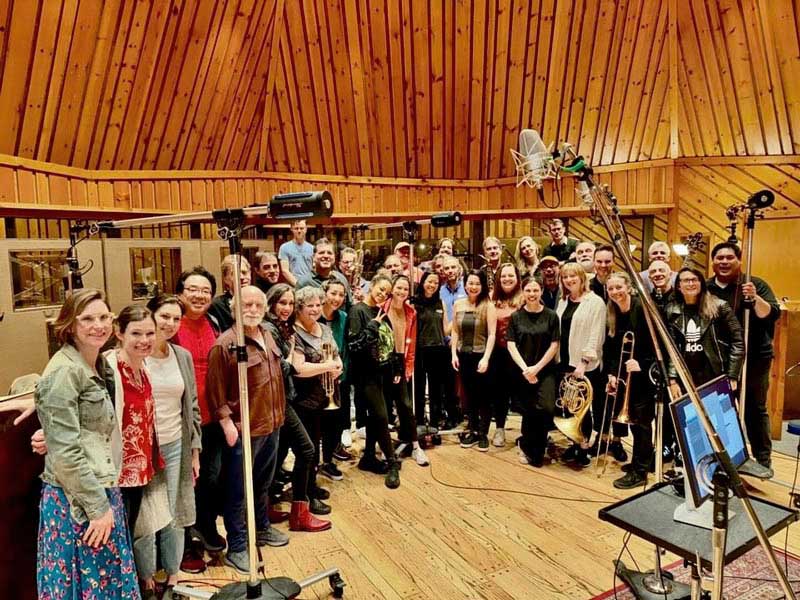
Album recording session for The Great Gatsby
──What are the joys and the pressures of working on Broadway?
“The joy is being part of brand-new work no one has seen yet. At readings or investor presentations, we develop pieces before they go public. It is thrilling to imagine how audiences will respond and to help shape a show from the ground up, something this theater district enables like nowhere else. At the same time, every department – direction, sound, lighting – brings in top-tier people focused on making the best possible production, so I feel the pressure not to hold anyone back. In a city where there are countless capable replacements, it is both fun and demanding to keep delivering a level that convinces everyone in the room.”
──At what kind of moment do you feel a sense of accomplishment?
“During my first year in this world, I didn’t know what to enjoy. I used to dislike musicals, and frankly I was doing it because it paid. Spider-Man was exciting because we could try new technology, but beyond that my motivation was not high. I actually preferred composing for wrestling.
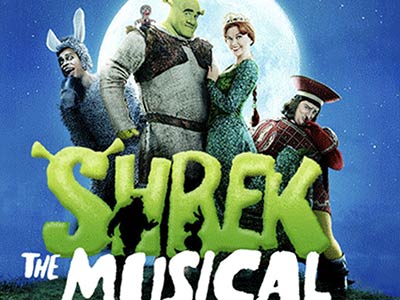
Then on the Shrek national tour, we visited a small rural theater in Washington State. One fascinating thing about the culture here is how impressive theaters appear in towns where you would never expect them. We often rehearse and tech in such places, then invite local audiences to gauge reactions.
When we performed Shrek there, many in the crowd were not used to theater etiquette, so people stood up, chatted, even took photos during the show. But their emotions ran high because the experience was new. Big laughs in funny scenes, tears in sad ones, even anger alongside Shrek. Watching that made me realize how exciting this job is.
I understood that the sounds I create can move people’s emotions that much. Since then, I have found real purpose. I get excited in development, wondering what will happen when an audience finally comes in for the production I’m creating. On performance nights, I sometimes walk the lobby during intermission to hear unfiltered reactions. People say whatever they want. Some leave early, some declare it the best musical. I love that time, and when the response is strong, I feel a genuine payoff.”
How to enjoy Broadway in New York: recognizing world-class craft on stage
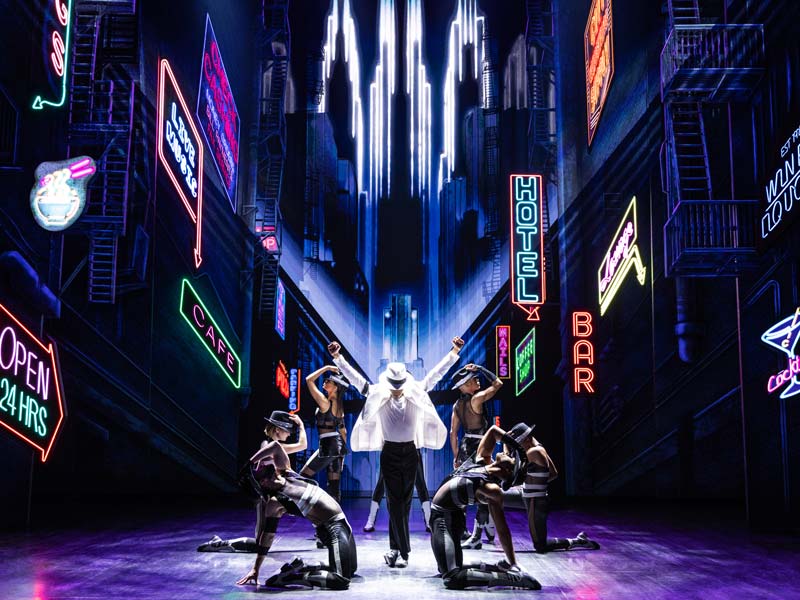
A scene from MJ(Photo by Production)
──What do you find compelling about New York?
“That it is an energizing city. The best of many fields gathers here, and new ideas keep emerging from this compact island. It is a great place to create. People on the East Coast are direct and straightforward. That can feel sharp at times, but I prefer honest communication to something wrapped in layers.
In the realm of performing arts, I would say New York is the country’s singular theater capital, with London’s West End on the same tier internationally. If we mean large-scale spectacle, Las Vegas also belongs in the conversation. A district that continually generates new work and presents it daily offers more chances to experience the stage and more opportunities to work.”
──I agree. And as a place to live?
“It helps that a car isn’t necessary, and the food scene is incredible, with cuisines from everywhere in the world. It is hard to imagine living elsewhere now. The city is not a stand-in for an entire country. It has its own character and a high degree of freedom. Even when someone is extremely different, nobody really minds like ‘Who cares?’.”
──What makes Broadway itself so appealing?
“In short, you can witness the pinnacle of the performing arts every day. Performers and creative teams bring elite technique together to build each show. I understand that not everyone senses that ‘greatness’ on a single visit, especially with limited time.
Theater can be hard to read. Watching one bad game does not make a baseball team worthless; knowing the level of training and selection behind those players changes how you judge a result. It is the same here. Every department is staffed by people who have beaten long odds to be chosen. Working on Broadway means more than doing assigned tasks with skill. You also have a responsibility to share knowledge, to speak about the art and its craft so the field keeps moving forward. Many here feel that duty and create with deep respect for the stage. If you look at that totality, the experience can be even more moving.”
──By the way, what are some of your favorite Broadway musicals?
“Favorites? From my own projects, I enjoyed Shrek and Young Frankenstein. Because I build shows, I like watching pieces that let me laugh without overthinking. I love bright, ridiculous comedies like Mel Brooks’s The Producers.”
What to watch for: sound, lighting, performers, and theaters on Broadway
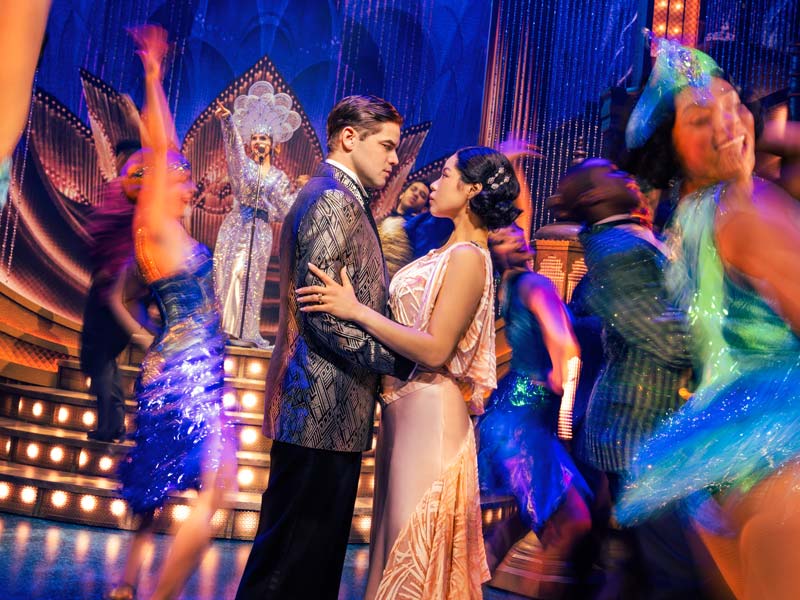
A scene from The Great Gatsby(Photo by Production)
──Could you talk about the strengths of Broadway sound and lighting?
“For each production, we can build systems from the ground up. After a run ends, the stage machinery and underfloor set are cleared to zero, then rebuilt for the next show. That is very different from short runs or touring formats elsewhere. Renting out an entire theater and constructing specifically for one production is a major strength here and a reason you cannot simply duplicate it in another market.
Designers choose gear, draft diagrams, plan placement and cabling, and spend immense time shaping the systems. On Broadway a ‘sound designer’ is not the person like me who creates sounds; it is the person who designs loudspeaker placement and signal flow. You need serious training in electricity, physics, and acoustics to do it.
For lighting, pay attention to video design as well. Video, lighting, and set designers collaborate so tightly that you will see moments that make you think, ‘Is that really video?’ The move from halogen to LED changed color and qualities of light dramatically, and both lighting and video keep advancing.”
──Beginners often focus only on performers, but there is so much technology at work.
“Another strength is the capacity and resources to adopt new tech when building from scratch. People invest in developing tools just for a show. In MJ The Musical, for instance, performers wear GPS units behind the ear so we can detect positions on stage. The system automates audio, video, and lighting to follow those movements. That alignment makes the experience feel more immersive and also frees engineers to focus elsewhere.”
──So Broadway’s economics are pushing technology forward.
“Exactly. When we think a certain tech would make it better, professionals gather and try it. Many of these experiments only work if you can fully integrate systems in the venue, which is why this theater district is uniquely suited to them.”
──What stands out about Broadway performers?
“Even leads audition. Nobody is guaranteed a role from the start. Of course there are exceptions when a celebrity like Hugh Jackman or Sutton Foster headlines a limited run built around them. Otherwise, we cast by asking who best serves the production, and those who win the roles are the ones you see. Watching with that in mind can be fascinating.”
──What makes Broadway theaters themselves special?
“Acoustics. Broadway houses have excellent resonance. Ceilings are curved, seating arcs, and there are alcoves and decorative elements like chandeliers and statuary that add texture. In short, almost nothing is perfectly straight. By contrast, many multipurpose venues in my home country are boxy with flat ceilings.
The key is that there are virtually no parallel surfaces. Sound bounces between parallels like a ping-pong ball. In curved or ornamented rooms, reflections scatter, which produces pleasing reverberation. Great theaters, studios, and concert halls are built to encourage that diffusion. Long before computer simulation, builders here understood it. Because these buildings were designed as theaters, their architecture focuses on serving live performance.
One venue I like outside this district has wonderfully irregular walls that diffuse sound, though seats tucked right against a rear wall can be less ideal. On Broadway, even mezzanine front rows sit relatively close to the stage with generous height above, and the sound benefits. Paying attention to room design, tone, and reverberation adds another layer of enjoyment.”
──Do you have a favorite Broadway house?
“The Neil Simon Theatre is very user-friendly. The size feels right, and the sound is beautiful. Many theaters here are excellent. Some are old with tight seating and imperfect amenities, but the classic atmosphere helps you feel transported before the curtain. Look closely at carvings, columns, and chandeliers – designers poured care into them. Each venue has its own theme, architecture, and style.”
Why innovation matters: shows that do not try new ideas struggle to stand out
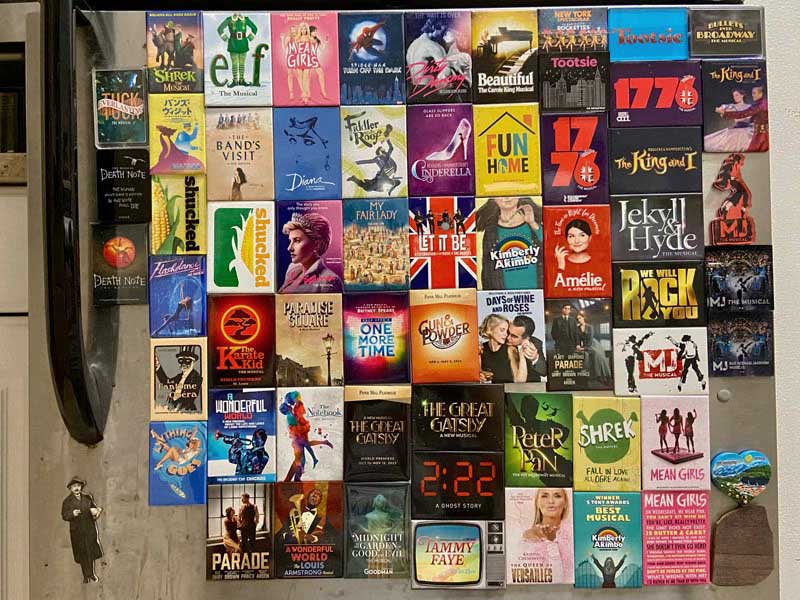
A collection of show magnets from productions he worked on
──What are your goals going forward?
“To keep creating new work. I am happy when my name appears in Playbill and my page grows with each production. On a revival of The King and I, I noticed the original creators from the 1950s listed alongside us. It made me think how meaningful it is to have your name remain when a work returns decades later.
I want to stay someone who builds originals. Every musical has a unique time and story, so every one is a fresh challenge. The more we push technically and musically into new territory, the more fun it is. Repeating old methods without trying anything new is the least interesting path.
Last year, The Great Gatsby did not attract much attention from the Tonys. It is a strong show with a lavish cast and plenty of song and dance, but it did not attempt anything truly new. Using traditional methods and dressing them up beautifully can still feel familiar to seasoned voters. That does not mean it is not good; it just did not feel groundbreaking.”
──That focus on novelty feels very Broadway.
“By that measure, MJ was exhilarating. Working with Michael Jackson’s catalog is daunting because everyone knows the records and many have trained their ears on his voice. We had to avoid imitation, avoid disappointment, and still exceed expectations. That kind of pressure is scary.
Which is why it feels so rewarding when the work is recognized and the production continues. Being trusted with cutting-edge projects in this competitive city is a privilege I hope to keep.”
The arc of music history and where Broadway might go next
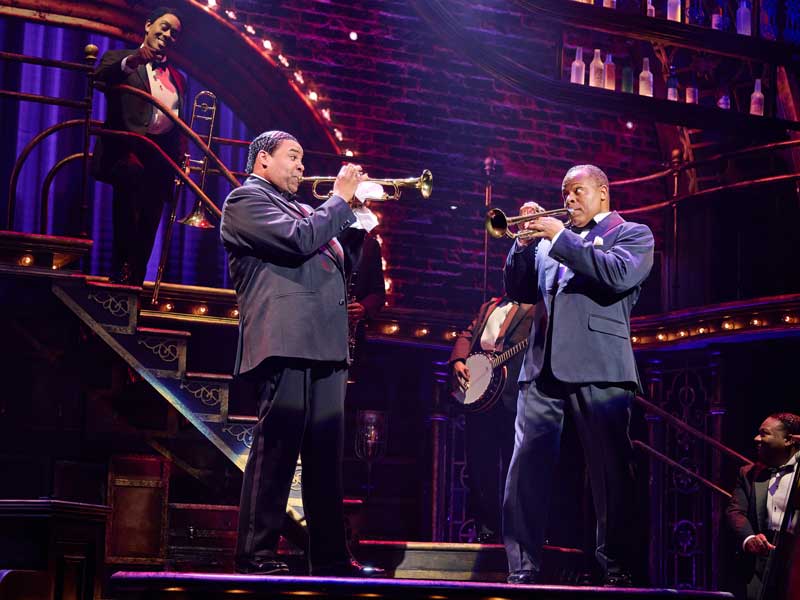
A scene from Wonderful World(Photo by Production)
──How do you see Broadway’s evolution?
“The ‘try new things’ mindset accelerated after Hamilton. Historically, art that repeats the past rarely lasts. In Beethoven’s time, many wrote like Beethoven, yet we don’t listen to them now. Even if they were excellent, so they were of the moment. Art keeps evolving, and those who simply match their predecessors tend to fade.
Musically, rhythm began with primal sound-making, then buildings introduced resonance. As structures moved from thatch and wood to stone, reverberation lengthened and harmony emerged. Large spaces capable of rich overtones were once only churches or castles, so music belonged to those institutions and the elite. Over time it spread, smaller venues developed their own harmonic languages, and things grew more complex through Wagner and beyond. Modernism pushed toward atonality, even to John Cage’s ‘4’33”’ where silence itself becomes the piece.
Beethoven was the first to break rigid forms, a true anti-authoritarian voice who shocked listeners by, for example, adding chorus to symphony. Broadway is similar. Without innovation, work gets buried. People in the 1950s who loved West Side Story might not have called Hamilton a musical, and fifty years from now the form may be unrecognizable to us. The goal is to enjoy the evolution while chasing the best possible stage.”
Inside MJ: an unusually long preview period and a company possessed by perfection
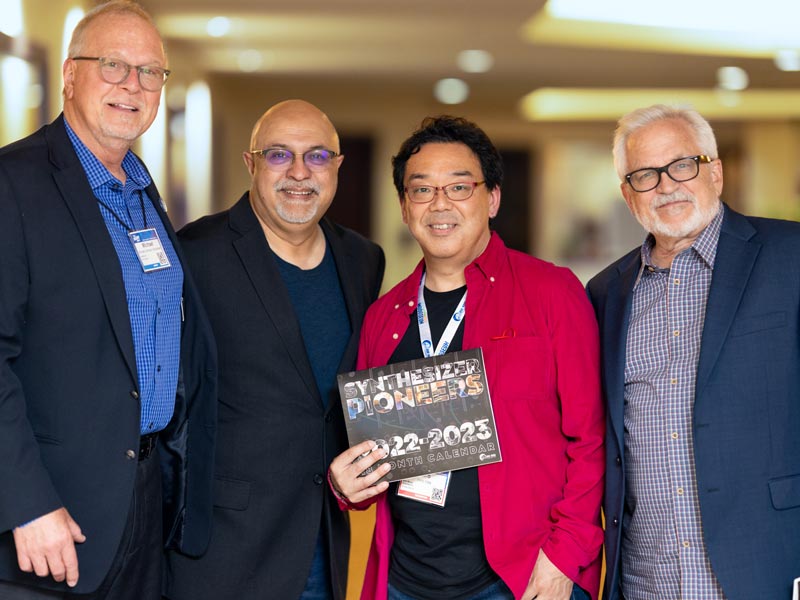
Legendary synthesists tied to Michael Jackson’s music. From left: Michael Boddicker (“HIStory,” “Black or White”), Amin Bhatia (“Thriller”), Hiro Iida (MJ The Musical), and Steve Porcaro of TOTO (composer of “Human Nature”)
──That group photo of synthesists who worked on Michael Jackson’s music is incredible.
“It was taken at the Bob Moog Foundation’s annual gathering – dr. Robert Moog being the father of the synthesizer. Forty notable synthesists from around the world are selected as advisors, and I am the only one from theater and the only person from my region. We said, ‘Let us get a photo of those connected to Michael,’ and took it there.
In a room like that, someone with a theater background really stands out. The proportion from my background is small.”
──We would love more people to see the shows you have worked on. What should audiences look for?
“In MJ, every sound went through the Michael Jackson estate for approval. Because it is a musical, we cannot sample the records; everything must be built from scratch and performed live. On top of that, the estate specifies which sounds define songs like ‘Thriller’ or ‘Beat It,’ and checks that we match the record closely enough. We earned their stamp.
──Matching the original while not using the original is quite a challenge.
It gets harder because these are 1980s tracks. Played in a modern theater, they can feel sparse. I design to lift certain elements so that today’s audiences hear what they expect, but pushing too far breaks authenticity. Many who choose MJ on their trip have listened to these songs thousands of times. They must feel right.
──So you balance show needs with fans’ expectations.
“Exactly. Producers asked for two things: stay as close to the records as possible and, where arranging is necessary, exceed expectations. It was a bracing brief. For me, the key listening point is whether the sounds are record-accurate or better. If we miss, it becomes a tribute act. Because the estate is officially involved, we cannot let it look like imitation.
On opening, people from the estate told me, ‘If Michael were alive, he would approve of these sounds.’ I felt proud in that moment. Later Prince Jackson said, ‘Thank you for honoring my father’s musical legacy.’ That helped lift the fear of disappointing devoted listeners.”
──Any other stories from making MJ? It has since opened in London, Sydney, and Hamburg.
“Our preview period was unusually long. A preview typically lasts about a month. For the first three weeks, departments make changes, then the producer issues a Freeze for the final week, meaning no more changes. After Freeze, if you change anything, new labor costs apply. I back up data, train operators, and stop attending daily.
MJ was different. The preview was set at two months, double the norm, and there was no preset Freeze date. By the previous night for preview of all the sixty shows, everyone was still there adjusting: sound, lighting, every team. People kept saying, ‘It feels like Michael has possessed us’ and ‘We know it will be better tomorrow, so we cannot stop.’
I made my final tweak to the Act Two sequence with Bob Fosse the day before opening. You would think no one would notice, but a dancer said, ‘Hiro, you changed that bit, right?’ and told me it completed a missing piece. The whole company chased perfection like that. Michael was famous for relentless studio work, and MJ carried that spirit through a two-month preview. In the end, we felt that even sixty days barely contained our ambition. If audiences sense that obsession, I am happy.”
──Another new title: what should we watch for in The Great Gatsby?
“The Great Gatsby opened in 2024, and the spectacle of Gatsby’s world is the draw. Set in the 1920s, so both the orchestration and keyboard programming aim for period feel. The orchestra is large, and across dance, choreography, and video we avoided a modern gloss that would break the era.”
──We were also impressed by Wonderful World.
“Wonderful World uses a small orchestra without strings. Yet the title song on the record does have strings, so I had to create them on keyboards. Like MJ, that track has been heard countless times. If the string sound feels fake, it ruins everything, which is scary but rewarding to solve.”
Paying it forward: why he shares skills and experience freely
Opening night of MJ(Broadway)
──You spend a lot of time with aspiring performers and technicians.
“In October 2024, when the Attack on Titan company performed in New York, I knew some cast members and brought a group backstage at MJ. Around ten came and we even stepped onto the stage after the show. They were moved, saying, ‘So this is Broadway.’ I explained that night’s lead was an understudy and that many of our cast are onstage almost constantly for eight shows a week. Several were shocked: ‘That quality from an understudy?’
People who practice a craft recognize elite talent more deeply. Standing on that stage, some realize, ‘That is my goal,’ while others thought, ‘This might not be for me.’ You only know by feeling it in person. Later a couple messaged to say the visit reset their ambitions.”
──What made you want to help like that?
“Back at Berklee, producer Arif Mardin visited. He had just won a Grammy for Chaka Khan and brought the multitracks to dissect the vocals for us. It was eye-opening to see a major figure share current work so openly.
There was a moment I will never forget. A talented student asked, ‘Singing well is essential, right?’ He replied plainly, ‘In the real world, image matters and visually striking singers are often chosen. Skill can be developed afterward.’ The room went silent. It was harsh but honest. I thought that was what a professional is. Since then I have wanted to be the kind of person who shares truth and lifts the next generation.
My mentor David Mash once told me, ‘People will start asking to meet you. Make time when you can.’ If listening and answering questions helps someone aim for this stage, I am happy to do it. If stronger competition follows, so much the better.”
New York is a city of chances: build the mindset to grab them
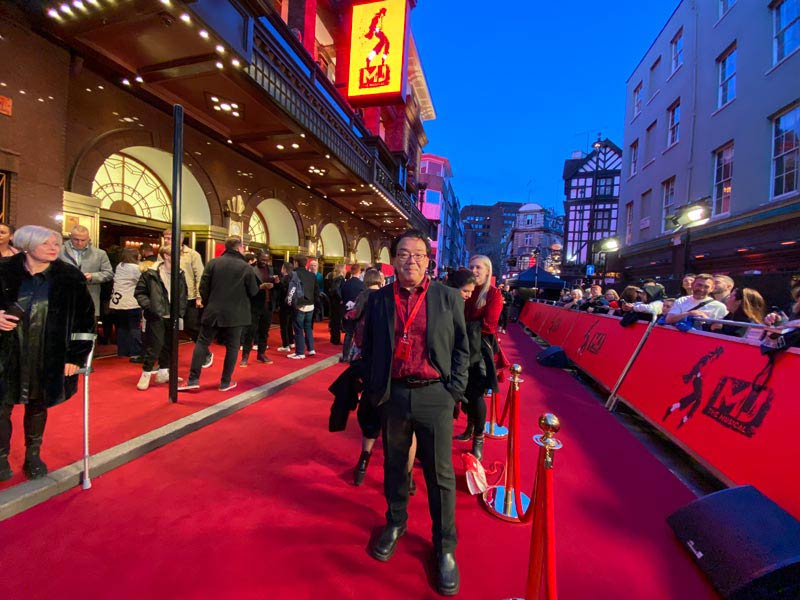
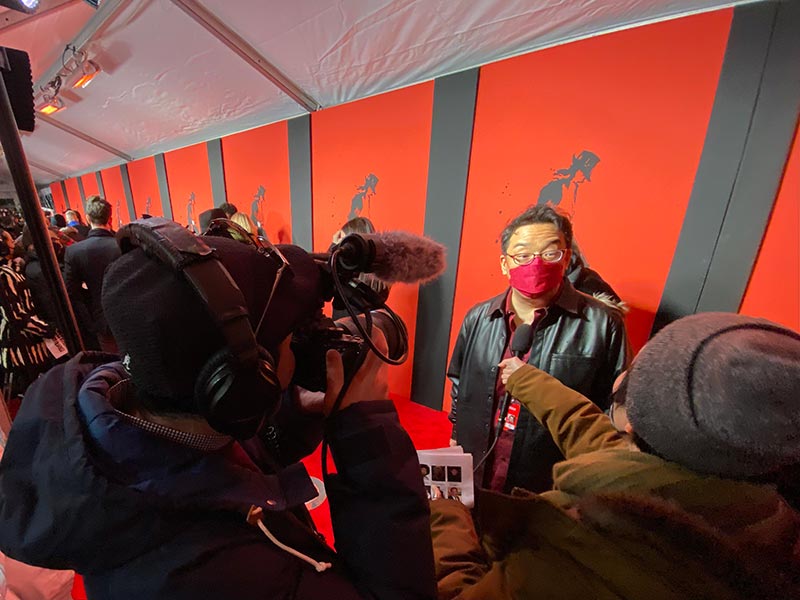
Red carpet at the London opening of MJ
──Lastly, what message would you like to share with people who want to build careers in New York or on Broadway?
“Study academically. Here, lighting, costume design, stage management people come in with shared vocabulary from university training. You also need a degree to qualify for visas. Unlike working within a single company, this is an individual sport. You are chosen for who you are. If you do not present distinctive methods and fresh expression, you will blend in.
New York offers chances like a conveyor belt. Before you arrive, develop the ability to seize them. A missed chance is quickly taken by someone else. Grabbing it requires everything to align: visa status, schedule, readiness. And remember, the people here work with a major-league mentality. To join them, you need the same mindset or you won’t last.”
──And as a musical fan yourself, what message would you like to share with international musical fans who are interested in Broadway?
“There is value in the journey a show takes. Roles are cast through auditions for that specific piece. Theaters are reconfigured for it. The most suitable sound and technical teams are chosen for it. Productions do not appear overnight. Over five to seven years, readings and tryouts involve many people, and then they open here. Because so many focus on one artistic point, if you watch with that in mind, the impact is greater.
Beyond the obvious ‘the acting is amazing,’ what makes this district special is seeing the work of professionals across every department, all striving to make something excellent. Enjoy it as it is.”
Editor’s note
Working on Broadway can feel distant. New York is often called the center of the world, and the local music scene is fiercely competitive. Behind the sparkle, hundreds or thousands vie for each role, specialized skill is demanded every day, and even then shows close within weeks if audiences do not respond. It is not something anyone reaches lightly.
Even so, Hiro’s stories draw the stage closer. He shares the behind-the-scenes reality of people who pour everything into making great work. Audiences pass judgment on the surface, but those onstage and in the pit and booth never treat a show casually. Everyone has a personal origin story and battles on the world’s highest platform. His line about ‘everyone being a major leaguer’ captures both the toughness and the pride here. Nothing is built like magic. Each challenge adds a layer of human intention. Try watching not only the plot but also the dream beneath it. ‘This is a stage built on someone’s dream, and we as the audience help complete it’ – and you may feel your heart catch.”
In a city where world-class talent collides, Hiro stands out for the trust he has earned. He often runs sound on four to six productions at once, dashing among theaters for final tweaks, then flying abroad to tune shows opening overseas. It is inspiring to hear such stories delivered with a smile. Travelers from anywhere who love theater should experience the sounds he has crafted live. And if this interview offers a glimpse behind the work and sparks someone to aim for the wider world, that is the best outcome we could hope for.
Written by Sayaka Imada
Musicals Shaped by Hiro Iida’s Sound Design




 Broadway Musical Discount Tickets – On Sale Now!
Find the best Broadway ticket deals right here – faster, cheaper, and backed by local expertise. Get ready to experience the magic of Broadway!

- Get discount tickets easily with instant booking
- The most detailed musical guides and reviews
- Dedicated support throughout your Broadway experience