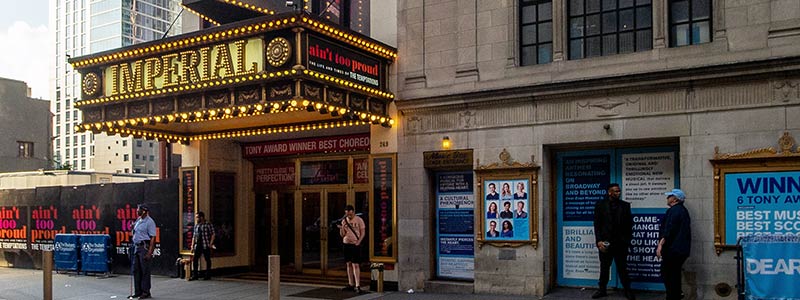
Address, opening, capacity of Imperial Theatre
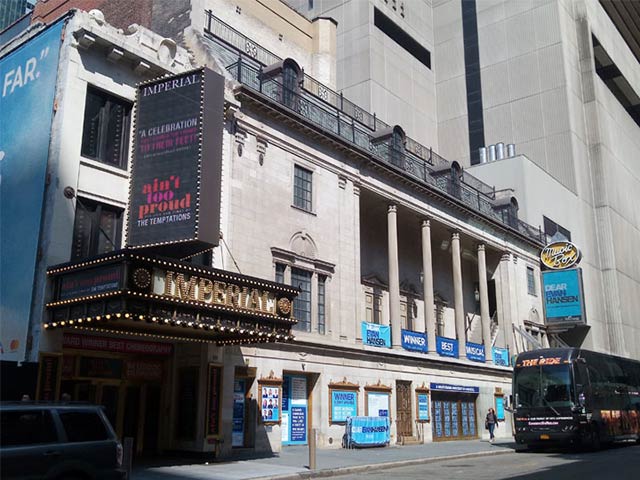
Basic Information about the Imperial Theatre in NYC
|
Address: |
249 W 45th St, New York, NY 10036(
Map )
Located on 45 Street, between Broadway and 8th Avenue
|
|
Opened: |
1923 |
|
Capacity: |
1,435 seats |
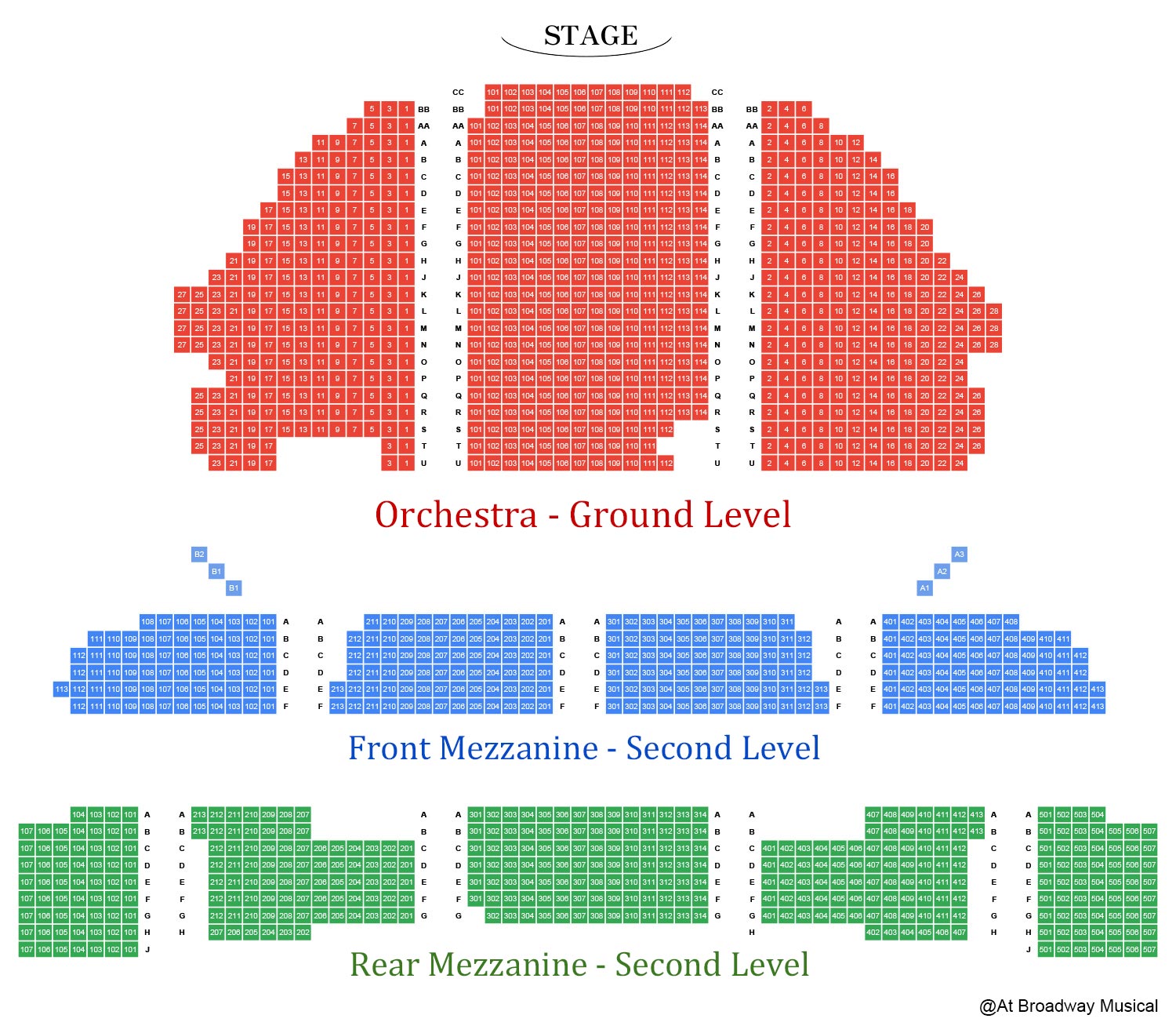
Seating Chart of Imperial Theatre
The Imperial Theatre has a seating capacity of 1,435 seats, divided into three main sections: Orchestra (1st level), Front Mezzanine (2nd level), and Rear Mezzanine (2nd level).
*Click to view larger image
Directions to Imperial Theatre
Access to Imperial Theatre are most commonly by taking the New York City Subway (MTA).
The area around the theatre becomes very crowded close to showtime, so whether you are arriving by subway or taxi, please allow extra time to reach the venue.
Map, location of Imperial Theatre
Here is the map of the Imperial Theatre.
Best hotels near the Imperial Theatre
Discover the best hotels near the Imperial Theatre. Stay within walking distance of Broadway and enjoy easy access to shows, restaurants, and attractions.
The list of recommended hotels near the theater:
History of the Imperial Theatre
Built on the site of the American Opera School
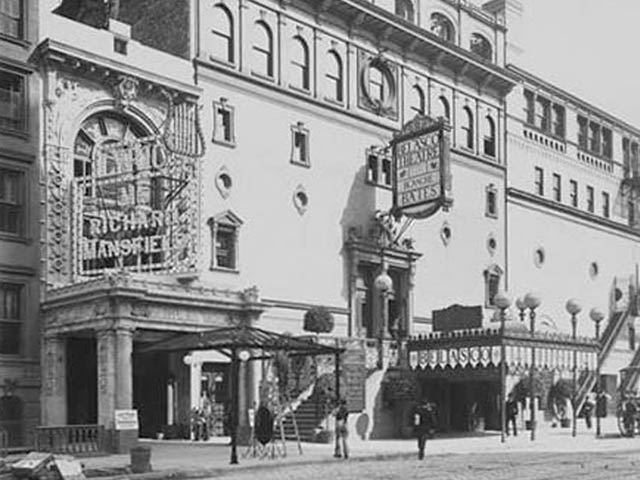
The Imperial Theatre was built in 1923 by the Shubert brothers, who at that time owned more than half of all Broadway theatres. The site was originally home to the American Opera School’s Lyric Theatre. As opera gradually fell out of fashion, the school faced financial difficulties and closed, and the property was sold to the Shubert Organization in 1903.
The Imperial became the
50th theatre built by the Shubert brothers, and they once again entrusted their favored architect Herbert J. Krapp with its design.
In the early 20th century, Herbert J. Krapp designed many of the Shuberts’ Broadway houses. Of the 19 theatres still operated by the Shubert Organization today, he was responsible for designing eight, including the Ambassador Theatre, John Golden Theatre, Winter Garden Theatre, Imperial Theatre, Majestic Theatre, Broadhurst Theatre, Gerald Schoenfeld Theatre, and Bernard B. Jacobs Theatre.
Architectural style of the Imperial Theatre
Herbert J. Krapp’s signature Adam style
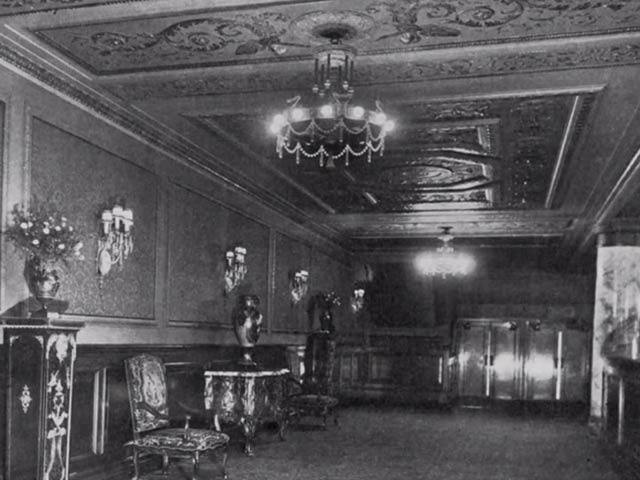
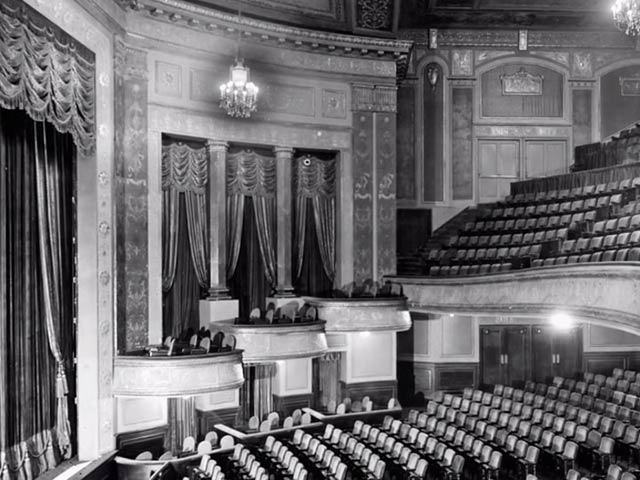
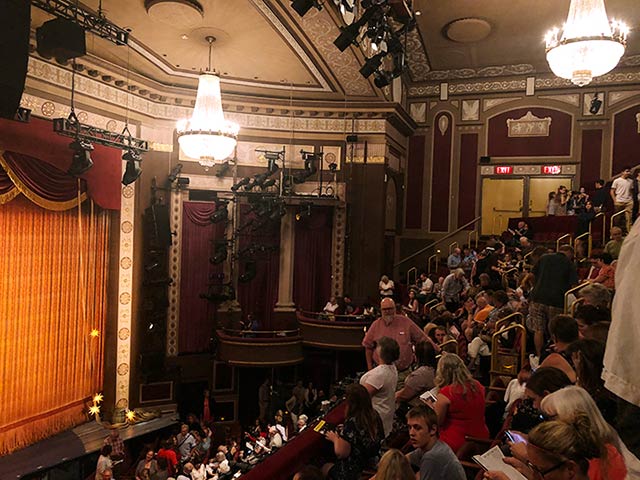
The Imperial Theatre was designed in the Adam style, a hallmark of Krapp’s work. This neoclassical style was established in the late 18th century by Scottish architects Robert Adam and his brothers. At the Imperial, ceilings, furniture, carpets, and even door handles reflect this refined taste. Panels decorated with floral and geometric motifs create harmony and elegance throughout the theatre.
Another of Krapp’s trademarks was maximizing space to create intimacy between actors and audiences. At the Imperial, the auditorium was designed to be wider rather than deeper, ensuring that all seats feel close to the stage and performers.
The Imperial’s current interior and entrance
Today, the Imperial still preserves much of Krapp’s Adam-style detailing. While elements such as curtains, seating, and chandeliers have been replaced, decorative wall panels remain as they were at the time of construction.
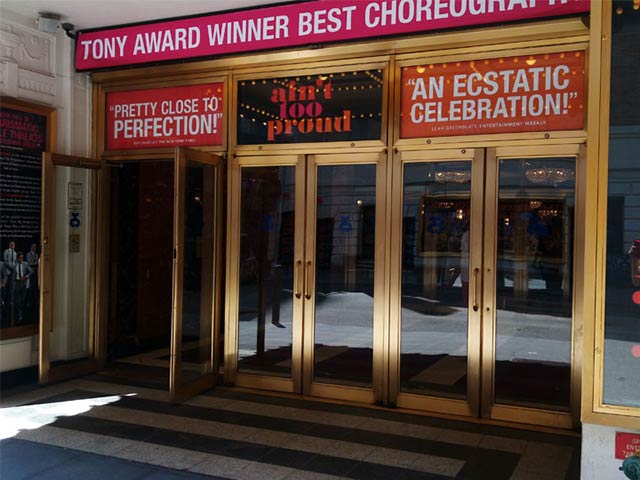
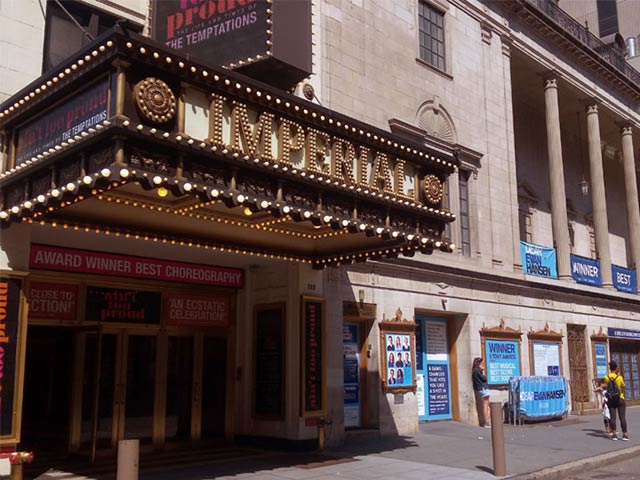
Why the entrance was placed only on 45th Street
The Shuberts owned several neighbouring houses along 45th Street, including the John Golden, Gerald Schoenfeld, Booth, Jacobs, and Music Box Theatres. To strengthen their theatre district empire, they intentionally placed the Imperial’s entrance on 45th Street, even though the building itself stretches between 45th and 46th Streets. As a result, no main entrance exists on 46th Street.
This somewhat forced placement left the theatre with a relatively small and discreet entrance, which some still find hard to spot today.
Notable productions at the Imperial Theatre
“Pippin” introduced Broadway’s first television commercial
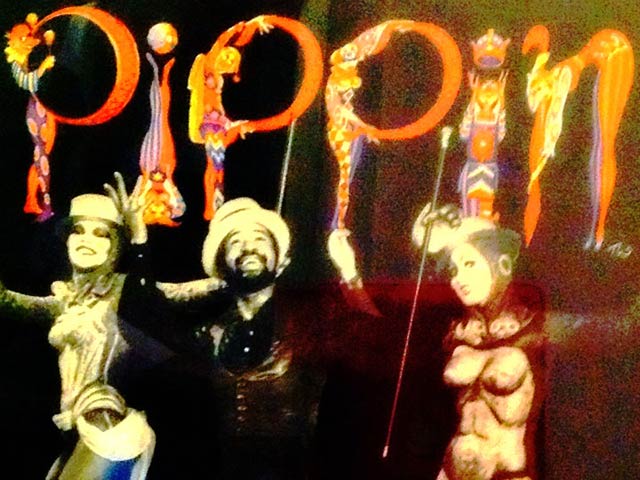
In 1972, choreographer Bob Fosse staged the original production of “Pippin” at the Imperial Theatre. The show earned 11 Tony Award nominations in 1973 and won five. To promote the musical, producers launched
Broadway’s first-ever television commercial, featuring 60 seconds of actual performance footage.
The ad showcased the number “Glory” and featured Ben Vereen (Tony Award winner for Best Actor in a Musical), dancer Candy Brown, and Pamela Sousa (Tony Award winner for Best Actress in a Musical). It ended with the line: “At the Imperial Theatre, you can enjoy the remaining 119 minutes of ‘Pippin’ live, without commercial interruption.”
The show was revived on Broadway in 2013 and won four Tony Awards, including Best Revival of a Musical and Best Direction of a Musical.
The Imperial’s longest-running hit: “Les Miserables”
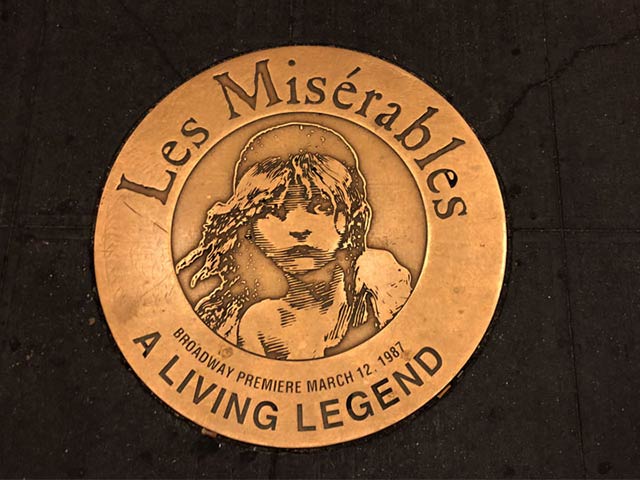
The Imperial Theatre is perhaps most famous as the home of “Les Miserables.” After transferring here in 1990, the production ran until 2003 with an astonishing 6,680 performances over 13 years, surpassing “Pippin” as the theatre’s longest-running show. To commemorate this achievement, a special “Les Miserables” plaque was placed in the pavement outside the theatre’s entrance.
The story reached new audiences worldwide with the 2012 film adaptation starring Anne Hathaway, Hugh Jackman, and Russell Crowe, which grossed $441 million globally (about \45 billion). In Japan, it became the highest-grossing movie musical of all time, surpassing “The Phantom of the Opera.” The success spurred a Broadway revival from 2014 to 2016, which played over 1,000 performances. Today, the original Imperial run remains the fifth-longest in Broadway history.
 Broadway Musical Discount Tickets – On Sale Now!
Find the best Broadway ticket deals right here –
faster, cheaper, and backed by local expertise. Get ready to experience the magic of Broadway!

- Get discount tickets easily with instant booking
- The most detailed musical guides and reviews
- Dedicated support throughout your Broadway experience



 Lines,
49 Ststation (About a 5-minute walk)
Lines,
49 Ststation (About a 5-minute walk)